CEUS Reproducing System Of My Bösendorfer Imperial 290 Piano
 Image Gallery
Interesting Articles
Links
History & Specifications
Image Gallery
Interesting Articles
Links
History & Specifications

CEUS and my Imperial Piano
"the capability to accurately record and to play back the full expressiveness of even the most talented pianist"
The Bösendorfer CEUS is an evolutionary improvement over the original 290SE; these have been the only options that gave Bösendorfer Imperial 290 pianos the capabilities of recording a performer, storing or transmitting the data, then having the file played back through the same or another similarly equipped piano. The CEUS's presented sense of the performance, the playback accuracy, are impossible for the human ear to distinguish from the original performance.
CEUS can play back a saved music file that you select, or play back a sequence of songs in the order desired. So an artist may record several songs, save them, then rearrange the songs within a directory to play back in their best sequence. Directories may be arranged appropriately to perform for events such as for Christmas, or dinner, dancing, etc. More about this at CEUS files page.
This explains CEUS, and how my own Bösendorfer Imperial piano came to be retro-fitted with CEUS in the Fall of 2009. Even today, most organizations that bought a 290SE (including University of Maryland nearby) or CEUS guard theirs jealously. I am grateful, especially as there is no other solution for the Imperial 290, that Bösendorfer Klavierfabrik GmbH developed the CEUS and that my Imperial piano has incorporates it.
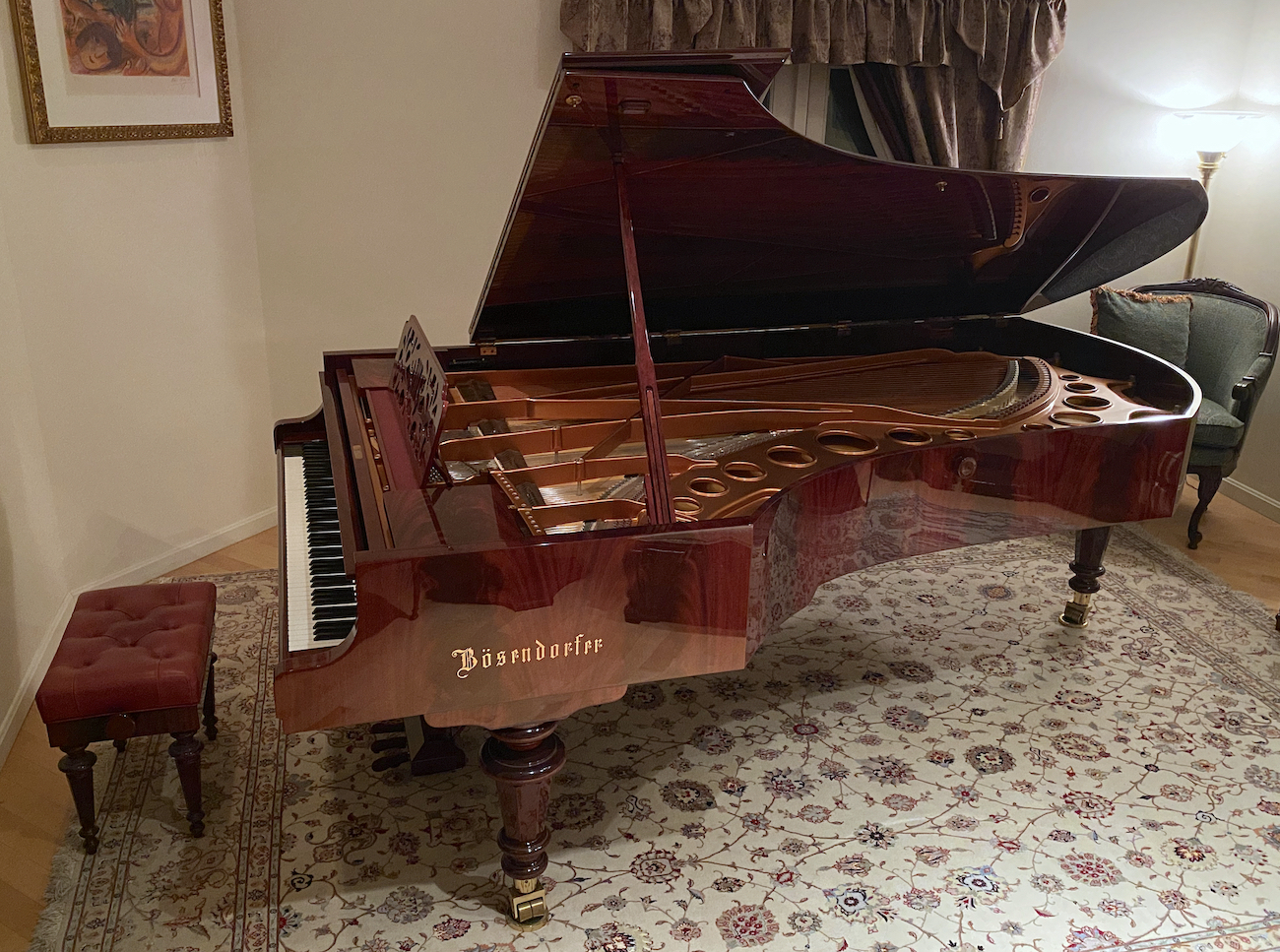
Right: Bösendorfer Imperial SN 44606, with CEUS, at home one evening in 2023. Five years after the piano arrived, in November 2005 I added the Persian silk and wool rug from Tabriz, Iran for aesthetics and to moderate the sound.
Click on the image to see enlarged view.
I understand technology has a short shelf life, and it continues to evolve. So I specified that any original components of my Imperial piano that would be modified to retrofit the CEUS were instead retained, while exact duplicates of these were made and modified to fit the CEUS. Should I ever desire to convert my Imperial back to its original appearance I can do so, or I may move forward to changeover to a newer technology if that ever becomes desirable.
Bösendorfer Klavierfabrik GmbH was acquired by Yamaha Corp. of Japan, and soon afterward the CEUS was discontinued. The companies developed the Bösendorfer Disklavier Edition, which is based on the Yamaha Disklavier Enspire Pro, a system explained at boesendorfer.com. The Disklavier series product however, is not available new or retrofitted for the Imperial 290 model pianos. Instead this was engineered for the Bösendorfer 170VC, 185VC, 214VC, 230VC, and 280VC pianos. So in a way the original Bösendorfer 290SE has come full circle; Yamaha based their original Disklavier on the never-patented technology developed by Wayne Stahnke for the Bösendorfer 290SE, and now Disklavier is offered with several Bösendorfer pianos.

Bösendorfer Computerflügel History - the 290SE: as I researched buying an Imperial piano I came across mentions of the Bösendorfer Model 290SE, an Imperial model that can be played as a conventional piano but also incorporates a sophisticated computer controlled mechanism to record a performance and then play it back autonomously. The 290SE was developed by an american MIT graduate engineer Wayne Stahnke (hence "Stahnke Edition") working with the L. Bösendorfer Klavierfabrik GmbH company, then owned by Kimball International, Inc. of Jasper, Indiana. The first instrument was completed for a private owner and delivered in June 1978. The SE system was then licensed to Bösendorfer where between 1984 and 1986 some thirty seven (37) SE's including 225SE, 275SE, and the 290SE Imperial model pianos with some 290 to 290SE conversions were built. About one third of the production were 290SE's that sold with an even then hefty price tag of $90,000 - adjusted for inflation this would be about the same buying power as $277,800 in 2023.
Right: Wayne Stahnke, innovative visionary who developed the SE which is the foundation upon which CEUS was developed.
Image courtesy of Mr. Stahnke.
The superb recording and playback accuracy of the 290SE was unprecedented. Those who enjoyed an opportunity to record on the SE, and historians who had old music adapted to play on the 290SE have paid this high compliments. Decades later the reliable 290SE remain sought after and continue in service; one of the 290SE remains cherished (along with its Microsoft DOS 3.1 computer) at the University of Maryland's Michelle Smith Library International Piano Archives in College Park, Maryland. Unfortunately owing to the high cost, the SE technology was not followed up by Bösendorfer, nor was it patented. However, this effort became the basis for pianos that would since December 1987 come to dominate this market even though technically and musically these did not surpass the 290 SE, and so the Yamaha 'Disklavier' became synonymous with modern recording pianos.
The CEUS: it was in the Fall of 2005 when I first learned about CEUS, a new computerized reproducing piano system developed by L. Bösendorfer Klavierfabrik GmbH working in collaboration with the Austrian engineering firm TVE Electronic Systems, and with the Vienna University of Technology.
When I first heard the term "reproducing piano" I imagined little Bösendorfer pianos being born, popping out of a reproducing piano. But CEUS was designed for two purposes: 1. to record performances on the piano, and 2. have the piano replay the performance in the highest possible fidelity. CEUS would expand upon the prior 290SE developments while incorporating advances of technology, including networking, and software improvements learned over the prior decades. The CEUS owes much to the original SE pianos including its optical shutters on the hammer shanks that provide hammer velocity sensing, closed-loop keyboard technology, and proportional pedaling. CEUS resulted in patents pending for a number of innovations by the collaborators on the project. The 'Bösendorfer CEUS' trademark was granted on 4 January 2006.
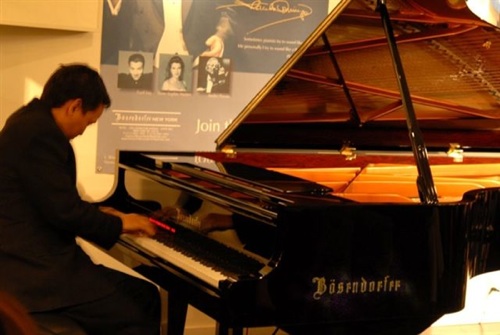
Right: a CEUS introduction event at Bösendorfer New York on 16 June 2007.
At first glance by a casual reader the introduction of CEUS might have appeared to be just another player piano system. But understanding the high standards set by Bösendorfer for their products, and knowing the history of the 290 SE, I imagined CEUS could be light years ahead of a system as capable as the 290 SE. I also hoped CEUS would have a very easy to learn user interface - at least better than DOS 3.0. In time I came to comprehend the CEUS is truly a technological leap transcending all previous recording and playback systems, allowing for the very first time the capability to accurately record and to play back the full expressiveness of even the most talented pianist.
The CEUS system exactly records the sequence of keys and pedals of the piano with heretofore unprecedented accuracy. Then CEUS can load the recorded data file and command the piano keyboard and pedals to exactly reproduce the performance. With CEUS one reproduces the performance beholding a piano as commanding as the Imperial is when repeating the exact rehearsal or performance - any time and at the pianist's convenience. The pianist could record the performance at their convenience, then play it back later on the same or similarly equipped CEUS piano. Alternatively, one could transmit the CEUS performance data (.boe) files elsewhere, to a studio with conventional microphones and recording gear, or to a concert hall with accompanists; as long as the destination has a Bösendorfer piano equipped with CEUS. Though there may be some subtle differences in how a pianist plays one instrument or another, or variation owing to the venue acoustics, or even the inspiration from the surrounds. CEUS allows one to study and critique, to record professionally, or simply set the piano to entertain.
For my needs, with CEUS I would no longer have to settle for a mere audio recording of guest pianists, these played through speaker systems that simply can not reproduce the qualities or sympathetic resonance effects of a live grand piano. The possibilities were sounding very exciting to me.
|
"like having a pianist at your disposal full time,
one with an uncommonly broad repertoire"
|
|
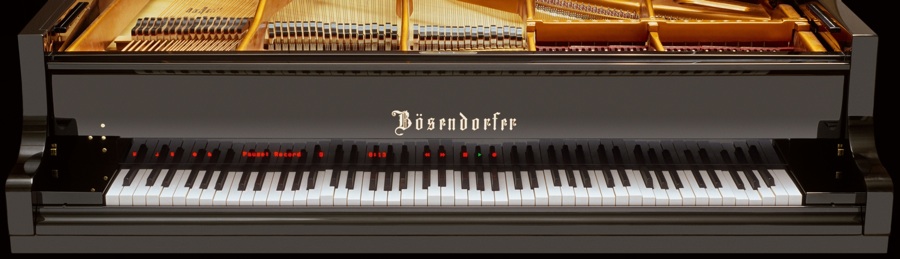
Above: Image from Bösendorfer showing a CEUS equipped grand piano in action.
Click on image to see enlarged view.
As explained by Bösendorfer literature:
"CEUS-Musical emotions and virtuosity are authentically reproducible: for the first time, a pianist can experience himself "live" from the listener's standpoint thanks to the CEUS reproducing system. Artists can record anywhere, without studio stress, without taking into consideration the entire musical span of a work. For the first time, direct live recordings are possible from a concert hall without disturbing background noise. Compositions and improvisations can be recorded and documented."
In this sense, for the owner of a Bösendorfer CEUS-equipped piano, it is like having a pianist at your disposal full time, one with an uncommonly broad repertoire.
The CEUS components are explained in some detail, and with illustrations, at my article Bösendorfer CEUS Maintenance Hints, but the core of CEUS is a personal computer with a hard disk where music performance data is stored in a digital format as a ".boe" file within directories. This is not merely an analog or digital recording of the audio track, but this is instead digital data of the performance keys and pedals sequence and timing. The .boe files are a fraction of the size of conventional recorded data. Furthermore, no information is lost or inadvertently modified when copying data from one CEUS piano to another, or from one storage device (hard disk, Memory Stick, etc.) to another. The data may be transmitted by a local network or through the Internet, by USB flash stick, etc. This provides some measure of immortality to the performer and also to his .boe data files. The CEUS is delivered with a sample digital song library of nearly one thousand five hundred files in .boe format. In time recordings in .boe format may be shared on the Internet, or transmitted by E-Mail, or imported from other devices for example. Elsewhere, that performance can be played back and recorded by audio microphones, at any studio that has a similar CEUS piano.

The piano playback volume will by default match that level as originally recorded, so assuming a song was recorded on an Imperial piano for example it will essentially be played back at the same volume on another Imperial. But by touching the control buttons up or down in increments CEUS will play back the recorded song louder or softer. It is just as though a pianist is being asked to strike the keys a little harder or softer; this does nothing to alter the piano itself. So if a performance recorded in a large hall is to be listened to in a room at home, one can reduce the volume to comfortable (and 'hearing safe') levels.

 Transposition (reading the music in one key while playing it back in another) is not a simple element of music theory, but for the CEUS doing this too is a snap since CEUS can transpose the song's key signature up or down by command with a push of the control buttons. This can be done even while the piano is playing back the song. Transposing the song can make life easier for your accompanying instrumental musicians or vocalist. Or one can change key simply to hear a familiar song played a bit differently.
CEUS could be ordered factory installed in any new Bösendorfer Grand piano from the Model 170 (5'8") up to the Imperial Model 290 (9'6"). Alternatively, a piano could be returned to the factory in Vienna so that with some modifications to the piano the CEUS can be installed onto Bösendorfer grand piano models 170, 185, 200, 214, 225, 280 / 280VC and 290.
The musicality of your Bösendorfer is not affected by having the CEUS installed furthermore, you need not even power-on the CEUS to play your piano. CEUS will no doubt provide many fine candle-lit dinners serenaded by any one of the many extraordinary artists whose efforts were saved for posterity in the CEUS library; that is this possibility that most stirred my imagination.
"Nothing less than 1:1
Welcome to a new dimension of recording and reproducing playing,
practice sessions or concerts on a grand piano."


Not Cues, but rather something between Seuss and Zeus: initially I was unsure about how to pronounce 'CEUS'. When I learned CEUS is pronounced like something between Zeus and the Seuss of Dr. Seuss fame ("Cat In The Hat", "Green Eggs and Ham", etc.), I was even more confounded about why Bösendorfer selected the CEUS name. When I first heard about it in 2005 at Bösendorfer New York they explained it was 'CEUSS' for "Computer Enhanced for Ultimate Super Sound", but since then I have seen it published only as CEUS. According to the earlier versions of both the German and English operating manuals CEUS is the acronym for "Create Emotions with Unique Sound", but this is in English. I tried to understand from where this originated while also wondering if the translation sounded better or made more sense in German (Emotionen erzeugen mit Einzigartiger Klang) but no, that does not work. I have noted neither the most recent operating manual nor the Bösendorfer web site explain the meaning of the CEUS acronym.
Image © Dr. Seuss Enterprises. Used by permission.
|
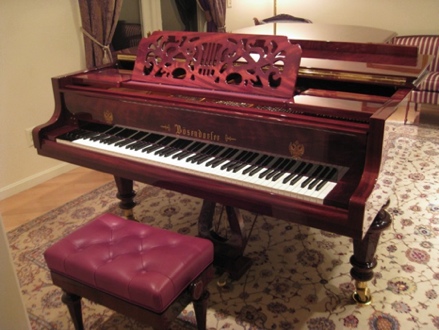

Above is the CEUS: as delivered installed into my Imperial Piano S/N 44606 on 28 December 2009. At left is piano with CEUS off, and to the right with the CEUS powered on.
The original Fall Board and legs were not modified but returned with the piano so that if ever desired in the future, the piano could be converted to its exact original appearance.
Click on the images above to see enlarged views.
The first moments I experienced the CEUS performing were eery and somewhat unsettling as the piano came alive to play Beethoven's Fifth Symphony; it was as though the ghost of Beethoven visited to perform. Below is a video recording of CEUS playing the first twenty four seconds of the Fifth Symphony as recorded by Milton Suskind and Arthur Loesser. This is a 47.3 megabyte file in Quicktime movie format. This video was made on that first night with a simple pocket camera, and just as my piano was delivered and before final tuning.
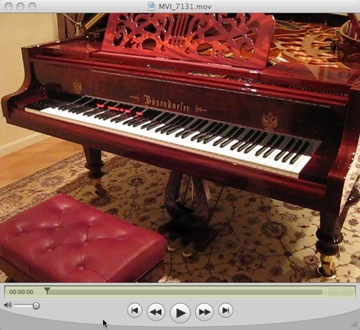
Above: impromptu recording by a compact digital camera so the video and audio quality are unremarkable, but it conveys a first impression.
The 47 megabyte movie is also available in a compressed format, view the above movie as an .mp4 of 6,864,398 bytes.
To view the above movie files pop-up windows must be enabled in your Browser.
"CEUS is a remarkable technological achievement;
superb for rehearsal, a tool for teaching, for research, and by recording CEUS provides immortality of sorts -
but this will remain foremost in my mind the gift of music from a most inspiring platform." M. Cohen
Since the CEUS arrived at my home I have experienced no other recording piano system beside the CEUS that can record anything that one or more pianists can throw at it (grave or presto, accelerando or rubato or ritardo, pianissimo or fortissimo, in any style, etc.) then play it back exactly as it was performed. If you close your eyes while the CEUS is playing then you think someone is there performing the thing. As I mentioned above, the first night alone with the CEUS in my home was almost eerie - observing the keys and pedals move while listening to the Beethoven composition performed as though his own ghost were on the bench!
CEUS Noteworthy Features:
|
|
|
• Comprehendible user interface: one does not have to be a Bösendorfer Engineer to operate CEUS.
• Among other things, by means of the precision of sampling which surpasses other systems by no less than a factor of 150 times.
• On each key, optical sensors keep measuring the key position and even the minutest key movement.
• Microprocessors and highly sensitive electro-magnetic controls (one for each key and pedal) ensure absolute authentic recording and reproduction in hitherto unsurpassed quality.
• By networking two or more Bösendorfer CEUS pianos accompanied by high-resolution video transmission of the pianist and professor, teaching could be accomplished "live" over a distance of several thousand kilometers with a delay of only about one second.
• Changes of ambient temperature or humidity have no influence on the CEUS since the system performs an automatic calibration process that will compensate for these effects.
• Precision of reproducing the moment the key is struck in under 2 milliseconds!
• Key motion after key is struck: 8 mm are sampled in 250 steps per millisecond.
• Pedal movements: The entire path is sampled in 250 steps per millisecond.
• Dynamic levels: Continuous progressively variable (infinite)!
• Communications in and out are possible by numerous ports including a LAN (Ethernet) port, USB, and MIDI (a lower resolution standard).
• The CEUS system is easy to use without an optional PC, but at the same time is completely PC compatible (Apple Mac running Windows, or Windows PC).
• By connecting a monitor and keyboard with mouse to the CEUS PC, or by a networked PC the CEUS music files can be backed up onto any PC or backup drive, or sent to around the world in seconds.
• Performance volume is adjustable - even while playing: set your Bösendorfer to play at a volume suited to a small room or to fill a large hall. Play as background music, or as the focus of an event.
• Performance key can be transposed - also while playing: simply push the control buttons up or down to effect + or - key changes. Make life easier for the vocalist, or for accompanying musicians, or just imagine hearing a familiar song differently!
• But don't worry: the amazing Bösendorfer sound will remain unchanged even after the customized CEUS fitting.
The approximately seven gigabyte CEUS digital library of music collection of songs provided with the system consists of recent and transposed historical recordings (classical music, dinner music, opera etc.) of famous pianists that you can listen to on your CEUS piano including: Vladimir Horowitz, Artur Rubinstein, and Sergei Rachmaninov.
|
|
Wireless 802.11n:
 On 6-7 September 2010 Jan Sauerzapf the lead CEUS piano installation technician from L. Bösendorfer Klavierfabrik and Tom Kaplan, a Registered Piano Technician (RPT) working for Bösendorfer USA, visited my home to retrofit my CEUS for secure wireless networking. This was the first installation of this capability for a CEUS piano in the field. The work included installing a new PC that incorporated the wireless LAN components and the attachment of three antennas. This system is based upon the current most efficient standard, 802.11n, a recent amendment which improves upon the previous 802.11 standards by adding multiple-input multiple-output antennas (MIMO) and many other new features. This followed some months of discussions with Bösendorfer GmbH.
The ramifications for networking two or more CEUS systems by means of higher speed wireless connections can only be surmised. But for me this means less wires visible as only one AC power line runs to the piano and into a nondescript surge protector/power strip. It also means that anyone who visits my home can connect (with the provided password) onto the network thereby communicating with CEUS too. New Bösendorfer customers will be able to order the wireless capability as a factory installed option for their CEUS. Fortunately, current owners of the CEUS can have this retrofitted to their piano by a Bösendorfer technician on site; the piano need not be returned to the factory to have this installed. By now anyone who wanted networking capability for their CEUS probably installed the Cat5/6 (or better) cables connecting to their CEUSs' networking port, connecting that to either a wall outlet or to some wireless device. For more information about this capability search the Internet, to see how this works refer to my CEUS wireless networking section.
In October 2023 I did belatedly update my CEUS Firmware to v1.36, being assured by the factory technicians that even this was not truly necessary unless I anticipated some uses for the MIDI features. I understand there is a Firmware 2.0, but for my simple needs this did not seem necessary.
BOEdit - .boe File Editing Software:
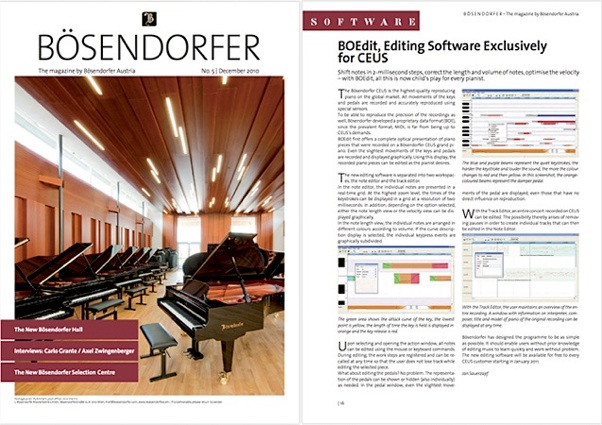 In December 2010 Bösendorfer Klavierfabrik announced their plans to release BOEdit, a new software written specifically to allow the editing of CEUS recording .boe files. The software features two workspaces: 1. a track editor, and 2. a note editor. This software will permit the shifting of individual notes within the data file of a recorded performance in 2-millisecond resolution increments, edit the length and volume of notes, and optimize the velocity of the notes. With this software you can edit the slightest movements of the piano keys and pedals too. In the track editor an entire performance may be edited; cutting and pasting portions, or editing out mistakes. Throughout these processes numerous 'undo' possibilities are possible too, though it is simple enough to periodically save complete working versions of each file too.
Best of all, BOEdit is easy to learn and use with a simple graphical user interface that will be comprehendable even for those people who have no prior music editing experience.
Right: Announcement of the BOEdit Software for CEUS and the cover page of Bösendorfer Magazine, December 2010 issue (99,239 bytes).
Click on image to read the article (517,579 bytes>.
BOEdit is a Microsoft Windows PC compatible software, but that can also run on modern Apple Macintosh OSX computers that are booted into a Windows operating system or are simultaneously running a Windows and Macintosh operating systems.
I had hoped it was possible that in time the .boe file standard may be even more widely adopted, so that some of the more capable third party music editing and recording software too will be able to read and work with the .boe data. In time third-party software too may even permit other functions including the synthesized playback of .boe files on a PC.
I wrote article about this development and describe some of the early versions of BOEdit at BOEdit: CEUS File Editing Software.
For Further Reading:
 Bösendorfer, No. 3 | November 2008. This color illustrated twenty (20) page periodical contains numerous articles including interviews with András Schiff and also with Ildikó Raimondi, news about the opening of the Bösendorfer flagship store in Tokyo, articles about piano manufacturing and maintenance. Of particular interest here is the article "CEUS Master Class at the Salzburg Mozarteum" explaining the Austrian-Chinese Music University Project where a networked master class was conducted between the Mozarteum University in Salzburg and the China Conservatory in Beijing with two Bösendorfer CEUS computer grand pianos. Contents copyright Feb. 2009 by L. Bösendorfer Klavierfabrik GmbH. Provided as an Adobe .pdf file (4,751,468 bytes). Bösendorfer, No. 3 | November 2008. This color illustrated twenty (20) page periodical contains numerous articles including interviews with András Schiff and also with Ildikó Raimondi, news about the opening of the Bösendorfer flagship store in Tokyo, articles about piano manufacturing and maintenance. Of particular interest here is the article "CEUS Master Class at the Salzburg Mozarteum" explaining the Austrian-Chinese Music University Project where a networked master class was conducted between the Mozarteum University in Salzburg and the China Conservatory in Beijing with two Bösendorfer CEUS computer grand pianos. Contents copyright Feb. 2009 by L. Bösendorfer Klavierfabrik GmbH. Provided as an Adobe .pdf file (4,751,468 bytes).
- Bösendorfer BOEdit: CEUS File Editing Software color illustrated article written by the author of this site providing an overview of the CEUS file editing software BOEdit. The article, currently based on version 1.07, includes screen shots of the software, a brief review of the Note Editor and Track Editor work spaces, and some thoughts about where the software might be going in its future development - or at least what the author might like to see.
- Bösendorfer CEUS File Organization and Networking color illustrated article written by the author of this site to help him and others better comprehend the file organization structure of the CEUS, how to connect to CEUS by means of Straight Through or Cross Over cables, by Wireless, and how to access the CEUS on a network.
- Bösendorfer CEUS Maintenance Hints color illustrated article written by the author of this site providing insights to the CEUS PC interior arrangement. Also covered are items the owner of a CEUS might want to know more about. This includes some advice related to the author's experiences of following the CEUS Service Manual, v2.00 English.
- CEUS Music Library Overview. This forty-seven (47) page document lists the music library available for the CEUS as of August 2008 by L. Bösendorfer Klavierfabrik GmbH. It lists the songs by title, composer, performer, date, type (concert, opera, salon, etc.). Information provided as an Adobe .pdf file (1,554,514 bytes).
 CEUS Music Library Overview Spreadsheet. This Microsoft Excel document lists the music library provided with the CEUS as of August 2008 by L. Bösendorfer Klavierfabrik GmbH. This is the same information as in the above file but ported into a spreadsheet format by the host of this site for the convenience of fellow CEUS owners. It lists the songs by title, composer, performer, date, type (concert, opera, salon, etc.) but since the information is provided as an Microsoft Excel file (148,703 bytes) the information can be sorted by preference of performer, composer, type of music, etc. CEUS Music Library Overview Spreadsheet. This Microsoft Excel document lists the music library provided with the CEUS as of August 2008 by L. Bösendorfer Klavierfabrik GmbH. This is the same information as in the above file but ported into a spreadsheet format by the host of this site for the convenience of fellow CEUS owners. It lists the songs by title, composer, performer, date, type (concert, opera, salon, etc.) but since the information is provided as an Microsoft Excel file (148,703 bytes) the information can be sorted by preference of performer, composer, type of music, etc.
 CEUS Music Library Overview Spreadsheet. Similar to the above but for convenience of Apple Macintosh computer users the information has been ported over (thanks to E. Zausmer) to an Apple 'iWork' Numbers spreadsheet format (217,596 bytes). The information can be sorted by preference of performer, composer, type of music, etc. CEUS Music Library Overview Spreadsheet. Similar to the above but for convenience of Apple Macintosh computer users the information has been ported over (thanks to E. Zausmer) to an Apple 'iWork' Numbers spreadsheet format (217,596 bytes). The information can be sorted by preference of performer, composer, type of music, etc.
- CEUS Service Manual, v2.00 English. This color illustrated twenty-two (22) technical service guide for the CEUS system, revised July 2011. There is very little of use here for the owner as only a factory-trained technician should ever be called upon to service a CEUS. However, this clearly illustrates and explains much about the CEUS components and how they interact. Contents copyright L. Bösendorfer Klavierfabrik GmbH. Provided as an Adobe .pdf file (1,755,630 bytes).
- CEUS User’s Manual, v2.02E English. This color illustrated fifty-six (56) page operating guide for the CEUS with operating system, revised 31 August 2011. CEUS is so capable a system that one should read the documentation and carefully explore the possibilities, there will be a learning curve. Contents copyright L. Bösendorfer Klavierfabrik GmbH. Provided as an Adobe .pdf file (2,756,859 bytes).
- Measurement and Reproduction Accuracy of Computer-controlled Grand Pianos by W. Goebl and R. Bresin, Proceedings of the Stockholm Music Acoustics Conference August 6-9, 2003. Journal of the Acoustical Society of America, vol. 114, no. 4, pp. 2273-2283, 2003. This is interesting reading comparing the 290SE system of the 1980's with the then state of the art Yamaha Disklavier Grand Piano. L. Bösendorfer Klavierfabrik GmbH was aware of this document and so it could be interesting to see how the modern CEUS improves upon the 290SE and Disklavier by repeating the experiment. The author of this site found the complete four page article online however, I am not sure if this can be freely distributed here.
Abstract: the recording and reproducing capabilities of a Yamaha Disklavier grand piano and a Bösendorfer SE290 computer-controlled grand piano were tested with the goal of examining their reliability for performance research. An experimental setup consisting of accelerometers and a calibrated microphone was used to capture key and hammer movements, as well as the acoustic signal. Five selected keys were played by pianists with two types of touch ("staccato" and "legato"). Timing and dynamic differences between the original performance, the corresponding MIDI file recorded by the computer-controlled pianos, and its reproduction were analyzed. The two devices performed quite differently with respect to timing and dynamic accuracy. The Disklavier's onset capturing was slightly more precise ('10 ms) than its reproduction (-20 to +30 ms); the Bösendorfer performed generally better, but its timing accuracy was slightly less precise for recording (-10 to 3 ms) than for reproduction ('2 ms). Both devices exhibited a systematic (linear) error in recording over time. In the dynamic dimension, the Bösendorfer showed higher consistency over the whole dynamic range, while the Disklavier performed well only in a wide middle range. Neither device was able to capture or reproduce different types of touch.
Contact the owner of this piano.
|
Contents © 2000-2024 Martin Cohen and Respective Contributors, All Rights Reserved
|
|

)
)
)
)
)
)