


|
C-7 Home Page  C-7 News
Consignment
Library
Products & Services
Product Lines
Order
Search C7.com
Availability
Distribution
Notes & Interesting Articles
Overview
Binocular Telescopes
Optical Accessories
Telescopes
C-7 News
Consignment
Library
Products & Services
Product Lines
Order
Search C7.com
Availability
Distribution
Notes & Interesting Articles
Overview
Binocular Telescopes
Optical Accessories
Telescopes
|
||

|
TEC REFRACTING TELESCOPES MECHANICAL ACCESSORIES
Right: TEC telescope rotatable 3-½ inch focuser, by Starlight Instruments, at Company Seven (58,791bytes). On the telescope there is a provision for attaching an optional Finder Telescope onto the Focuser Body. The APO180FL at right for example is shown with the warning label that comes from the factory, this is affixed with the two bolts that would usually be used to attach a finder quick release base bracket. Notice that especially on the larger telescopes there is a marked rise from the focuser body up to the level of the optical tube, conventional finder brackets will not clear this so TEC offers a bracket that is made to allow enough of a rise so that the platform will clear the optical tube, and even clears the added height of the TEC telescope OTA Mounting Rings. Company Seven offers additional services and hardware so that our clients can attach a broad variety of auxiliary finder and/or photo-guiding telescope(s). These larger TEC focusers will include reducers down to 2 inches, and with a slip-fit TEC cover. Each can be adapted with options including motorized electronics for local or remote control, this can even be fully automated to compensate for changes of ambient temperature. Each lens cell and focuser are squared onto the tube in preparation for the final assembly and final collimation (alignment) of the telescope.
| |
|
TEC CAPTAIN'S WHEEL
Right: TEC telescope rear cell flange with “Captain's Wheel” attached. At Company Seven (36,134 bytes). The focuser of the larger TEC telescopes, those with apertures of 160, 180, 200 and 250mm, produced over the recent decades* incorporate a “Captain's Wheel”. Many of the TEC telescopes made predating this feature can have it retrofitted; Company Seven can advise, and even arrange this for our customers.
To Wheel, Or Not To Wheel? We at Company Seven were well acquainted with these devices, they are on many of the larger observatory refracting telescopes that we have worked with. However, we were not used to seeing them on portable or trans-portable telescopes. When we first observed them being provided by TEC we honestly had mixed feelings about them:
It was only after we started to exhibit (at our Laurel, Maryland showroom) and deliver TEC telescopes that incorporate the wheel, and also receive feedback from our own customers, that we became convinced:
It is convenient to grasp even when wearing gloves, yet not protruding so wide that it hinders operating the refractor when pointing it towards zenith.
Left: TEC Captains Wheel installed on APO180FL rear cell flange, exhibited at Company Seven (36,134 bytes). The implementation is durable and reassuring; this will not fall apart on its own. While the engineering and precise execution are sound, the high qualities of the precision-machined metal alloy, and its black anodized finish, complement the aesthetics of the telescope as well. For those who work to bury their telescope optical tube under all manner of cabling for imaging cameras, auto guiders, robotic this and that, dew and frost prevention heaters, the wheel provides a good anchor for fastening device(s) cabling. Because the Captain's Wheel is bolted on, it can be removed by the user if ever desired.
| ||
|
TEC HINGED MOUNTING RINGS TEC offers optional Mounting Rings, sold by the pair, to attach the telescope optical tube assembly onto the platform of a suitable mount. These are made of aluminum alloy, precision machined in the United States. The TEC mounting rings are anodized black (some have come in white) for their 180, 200 and 250mm telescopes. Rings for the 140 and 160mm are finished with the same powder coating to match the optical tube barrel. We appreciate their low profile and reduced weight and professional appearance. The TEC split-ring hinged arrangement features comparatively lower profile, sleekly outer radiused halves. The inner radius of each ring is lined with a durable svelte non-marring fabric. Fastener: TEC implements a fastening mechanism that is not typical of the industry. After some initial skepticism, we also came to appreciate the reliable operation of these fasteners. The TEC Mounting Rings each feature a quick-release mechanism so that it is quick and easy, even with a gloved hand, to open unlatch or latch the ring closed. The mechanism is made of durable stainless steel, with a hand latch that can be snapped open to release tension on the rings. The fastening mechanism latching post's effective length is adjustable, so proper tension holding the optical tube can be set and maintained. The tension will not change on its own, the metal of the rings and their lining material will adapt to minor changes of tube diameter owing to any ambient temperature changes. The latching post can be disengaged from the bottom ring to completely open the rings and dock a telescope optical tube into the lower half rings. Then the upper rings halves are pivoted down, the fasteners are latched to secure the optical tube in place.
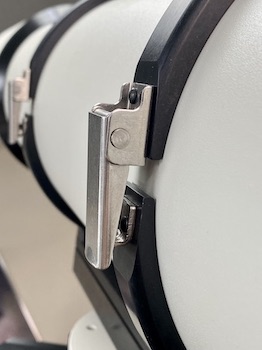
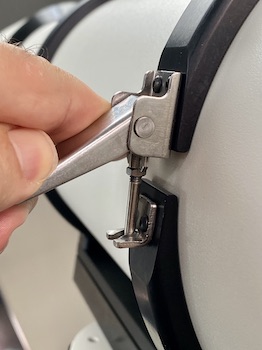
Above: TEC hinged Mounting Rings with locking mechanism fastened at left, and unlatched at right. The mechanism is essentially either snug and on, or disengaged: there is no halfway point. Company Seven is fine with this because it can be risky to slide an optical tube forward or back while in the grasp of its mounting rings because this risks having even a slightest bit of debris caught in a tightened ring lining scratch the beautiful powder-coated finish as you slide the tube along it. Company Seven recommends dovetail hardware to facilitate installing/removing a telescope optical tube assembly with its mounting rings attached, while also making it easy to loosen and rebalance an OTA along its longitudinal axis. So just prior to fastening the rings halves together, the user can gently slide the telescope optical tube forward or back to attain approximate optimal balance. Should the accessories payload change the center of gravity notably, then the telescope with mounting rings attached to a dovetail plate could be adjusted by sliding the entire assembly forward or back, then secured in place.
Right: TEC Mounting Ring view angle showing top platform, exhibited at Company Seven (29,848 bytes). The top flat area of the rings allow attaching accessories in what we term a piggy-back arrangement. This payload can be attached by bolting it onto the top of the ring, such as a with photo-guide telescope's mounting ring. Or another dovetail plate can be attached, spanning the tops of both rings, to allow sliding a payload on or off. Extra mounting rings could be attached onto the telescope optical tube as 'hard points' at which to attach other payloads too.
| ||
|
Carry Handle: to facilitate carrying the telescope optical tube assembly with its Mounting Rings attached. This option is bolted onto the Mounting Rings' top platforms, spanning both rings. The stainless steel hex bolts are included. 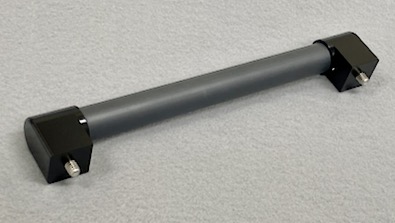
Above: TEC Carry Handle exhibited at Company Seven. This is the 9-inch length version, a 12-inch version also available. This accessory makes it easier to attach a telescope on to, or remove it from a mount. It can make it a little easier to open and close the TEC Mounting Rings, both with the same motion, since the two rings are connected by this bar. The selected dovetail plate length must space any mounting rings at a length corresponding to the length of the Carry Handle. With the Carry Handle attached this precludes piggy-back arrangement, whether it be a spanning plate or other device. However, this handle can be easily removed in the field to open up the Rings top platform for other hardware. Hints about using mounting rings:
|
||

|
Contents Copyright 1994-2026 Company Seven All Rights Reserved |

)
)
)
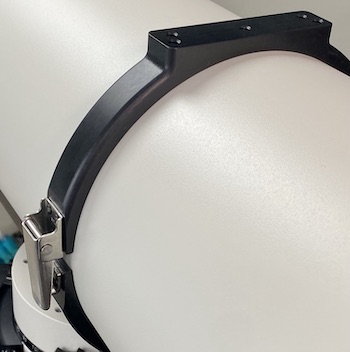 Accessory Platforms: each ring features a precision-machined flat platforms at top and at bottom. These platforms incorporate holes, including one at center and four others, tapped and threaded corresponding to some popular telescope accessory hole standards. The platform at the bottom allows you to bolt the telescope directly onto a flat plate of a mount. More commonly, we attach an optional dovetail plate to span the bottom of the two mounting rings; this arrangement makes it easy to slide a telescope on to, or remove it from a mount. The dovetail plate arrangement also facilitates fine adjusting the telescope balance to and fro, along the longitudinal axis.