

C-7 Home Page  Consignment
Library
Products & Services
Product Lines
Order
Search C7.com
Consignment
Library
Products & Services
Product Lines
Order
Search C7.com

OBSERVING PLANNING AIDS - Night Sky, Sun, Moon information.
 Weather Sky Clock for Washington, D.C. area (updated automatically)
The Sky Above Company Seven. The default shows the sky over our showroom in Laurel, Maryland. When page opens then you may scroll to the bottom of the page to enter your observing location, time, date, etc. Note that Universal Time is 4 hours ahead of Washington, D.C. EST, or 5 hours EDT. Click on any area of the map to see an enlarged detailed view.
Observing Tips for The Month a text discussion of the Moon, planets, and other interesting celestial objects in the night sky from night to night. Updated monthly. This is a public service provided by Company Seven and the University of Texas McDonald Observatory.
Complete Sun and Moon Data for One Day Complete Sun and Moon Data for One Day. You can obtain the times of sunrise, sunset, moonrise, moonset, transits of the Sun and Moon, and the beginning and end of civil twilight, along with information on the Moon's phase by specifying the date and location. This is a public service provided by the U.S. Naval Observatory Astronomical Applications Department through Company Seven, used by permission.
We will keep you posted!
10 May 2011: Company Seven delivered another interesting optical system for NASA to fly later in 2011. This is a ruggedized and shock/vibration resistant catadioptric system with all optical components made fully quartz (fused silica), and with superbly engineered and applied high transmission coatings optimized for its designed transmission application. In order to maintain perfect focus at all operating temperatures the construction of the tube assembly and many mechanical components are largely of Invar, an ultra-low expansion aerospace grade alloy.
)
)
20 March 2011 Event: Company Seven Supporting NASA Sun-Earth Day educational activity. This year's theme was be 'Ancient Mysteries-Future Discoveries', opening the door to a much deeper understanding of our Sun and its impact on our Earth across the ages. We will also consider how the Sun continues to impact our daily lives. Because the event day was on a Sunday this year, Company Seven's showroom activities in support of this occurred on Saturday 19 March.
20 March 2010 Event: Company Seven Supporting NASA Sun-Earth Day educational activity. This year's theme was a celebration of the International Year of Astronomy.
 4-5 December 2008 Event: Martin Cohen of Company Seven is guest of the Worchester Polytechnic Institute "Integrative Materials Design Center" speaking on the subject of "Long Distance Microscopy for Materials Evaluation".
The WPI Integrative Materials Design Center (iMdc) is formed through an industry/government-university alliance, and its program is built in direct collaboration and with active participation and insight from its industrial/government partners. The center is conducting fundamental research which addresses well-identified industrial applications of general interest and relevance to the manufacturing sector - an "Application-Driven-Design" approach. Consortium members include: Alcoa, Army Research Laboratories, Benet Laboratories, Boeing, Caterpillar, General Dynamics Land Systems, General Motors, Hamilton Sundstrand, Harley-Davidson, Honda, Mercury marine, NASA Langley, Pratt & Whitney, P&W Rocketdyne, Rio Tinto Alcan, Sikorsky.
Read more about the work of the WPI iMdc and an overview of the presentation by Mr. Cohen.
20 March 2008 Event: Company Seven Supporting NASA Sun-Earth Day educational activity. This year's theme will be "Space Weather Around The World".
9 August 2007 Company Seven Acquires Biosphere 2 Astronomical Observatory. This is designated our 'MCCM' Observatory Project. The system was relocated to Maryland and initially loaned to the Johns Hopkins University Applied Physics Laboratory for an eight year term through July 2018. We will relocate it, hopefully somewhere locally, where it can be dedicated at least in part for uses in science education.
20 March 2007 Company Seven supporting NASA annual 'Sun-Earth Day 2007' educational activities. This year's theme will be "Living In The Atmosphere of The Sun".
20 March 2006 Company Seven supporting NASA annual 'Sun-Earth Day 2006' educational activities. This year's theme features natural and artificial eclipses!
The system furnished by Company Seven was our Astro-Physics 206mm f/8 EDF telescope with a Astro-Physics 90mm f/5 Stowaway "finder" telescope on an Astro-Physics 1200GTO German Equatorial Mount. The system was equipped with our Baader Mark V Großfeld Binocular Head, a top of the line system providing high resolution binocular views through the telescope. We employed a selection of TeleVue Panoptic, TeleVue Nagler, TeleVue Radian, and a matched pair of Carl Zeiss Abbe Orthoscopic series eyepiece sets and filters. While this was a good "practice run" for us, the seeing conditions were marginal with notable humidity and sky glow. Therefore, the telescopes were limited by seeing conditions to moderate magnifications on the order of 300X or less. Regardless of the seeing limitiations, the large number of visitors were nonetheless enthralled by Mars. Later in the session we did study a number of the brighter popular deep sky objects, and later Saturn!
As described by the AMU staff "technology is driving a revolution in amateur astronomy. Improvements in telescopes, computerized data, cameras, and more means backyard stargazers now have access to information that only a few years ago would have been limited to the hands of experts. A look at the technology of amateur astronomy -- and what you might discover by just looking up."
To read an more in depth review of the program with links to the program Web Site and a link to download the program in Real Audio file format please click here.
JUL 10, How to Catch a Comet, David Levy
To read an overview of the presentation by Mr. Cohen, click here.
5 November 2005 Company Seven supporting Howard Astronomical League "Mars Watch" event from 5:00 pm to 3:00 am. Company Seven provided a telescope and staff to see the Opposition of Mars at the Belmont Mansion, off Elibank Drive in Elkridge, Maryland. H.A.L. and Howard County Community College jointly sponsored this event which was open to the public at large. Company Seven assists at such events as a public service insisting on no promotional efforts on our behalf.
21 June 2005 Martin Cohen of Company Seven is among a panel of three in a discussion with the program host about amateur astronomy technology on the WAMU American University Public Radio "Kojo Nnamdi Show" weekly "Tech Tuesday" program.
20 March 2005 Company Seven supporting NASA annual 'Sun-Earth Day' educational activities. This year's theme is "Ancient Observatories Timeless Knowledge".
20 March 2004 Company Seven supporting NASA annual 'Sun-Earth Day' educational activities. This year's theme features the Transit of Venus coming 8 June 2004, this will be the first such transit visible since 1882!
17 July 2003 Martin Cohen of Company Seven is among the guest speakers for Smithsonian Institution Resident Associates Summer Program "Amateur Astronomy: It's All in the Stars … and Comets, Planets, and Moons". Topics and speakers include:
JUL 17, Your Telescope, Martin Cohen - the location of this session changed to S. DILLON RIPLEY CENTER
JUL 24, Heavenly Bodies' Shape and Motion, David Dunham
JUL 31, Using Cheap Webcams and Freeware, Geoff Chester
AUG 7, Upstairs/Downstairs, David DeVorkin
AUG 14, Following Stars, Janet Mattei
27 November 2001 Company Seven activates new DayStar Calcium K Line Filter for Solar Observing!
Company Seven was among the first in our industry to go 'on-line' with www.company7.com, that was back in 1994. Our site continues be hosted by us, with our content including many informative articles about the history of amateur astronomy, telescopes, binoculars, and of our other products; these and our other content were intended to inform and amuse customers and fellows of like mind in our community. By about 2006 we were routinely encountering rampant plagiarism and copyright violations of our original content by numerous E-Tailers, other web sites, numerous forums, etc., this was well before the bots of AI started scraping (stealing) our content. It was kind of flattering that our advice was “The Gold Standard” however, this theft of our work discouraged us, so we have pretty much slowed or discontinued altogether providing advice online, or updating the consumer products sections of our web site. Instead, we prefer to meet you at our showroom, speak by phone, or communicate by E-Mail as time permits.
 Recent Changes at C7's Web Site
Owing the the increasing size and complexity of our site, we will work to update this page in order to help our customers find the changes or news of interest.
Changes in May 2026:
.
) In May 2026 Company Seven completed conserving another historic binocular, adding this to the permanent exhibit of World War II era U.S. Navy binoculars in one of the display cases at our Laurel, Maryland showroom. The U.S. Navy Mark 45 Mod. 0 is among those binoculars mentioned in our article about the U.S. Navy Mark XLIV Mod. 0 produced by SARD. This was contracted in 1944 from Hayward Lumber & Investment Co., Chemical & Manufacturing Division, Los Angeles, California. The Mark XLIV Mod. 0 and Mark 45 Mod 0 and were the last two wartime 7x 50 binocular production contracts issued by the U.S. Navy Bureau of Ships. The Mark 45 Mod. 0 is among the rarer U.S. binoculars of World War II. But what is truly rare is to find one of these arrive, 82 years after being made, complete with carry case and accessories and in such good condition; this is why we selected this particular Mark 45 Mod 0 (among the last produced) for conservation and protection on permanent exhibit.
In May 2026 Company Seven completed conserving another historic binocular, adding this to the permanent exhibit of World War II era U.S. Navy binoculars in one of the display cases at our Laurel, Maryland showroom. The U.S. Navy Mark 45 Mod. 0 is among those binoculars mentioned in our article about the U.S. Navy Mark XLIV Mod. 0 produced by SARD. This was contracted in 1944 from Hayward Lumber & Investment Co., Chemical & Manufacturing Division, Los Angeles, California. The Mark XLIV Mod. 0 and Mark 45 Mod 0 and were the last two wartime 7x 50 binocular production contracts issued by the U.S. Navy Bureau of Ships. The Mark 45 Mod. 0 is among the rarer U.S. binoculars of World War II. But what is truly rare is to find one of these arrive, 82 years after being made, complete with carry case and accessories and in such good condition; this is why we selected this particular Mark 45 Mod 0 (among the last produced) for conservation and protection on permanent exhibit.
Now exhibited at Company Seven's showroom (31,831 bytes)
Click on the image to see an enlarged view, popups must be enabled (117,611 bytes).
The performance of the Mark 45 Mod. 0 is similar to the other general purpose U.S. military service 7x 50 binoculars of the era, even sharing some components. So the qualities of view, including the fifty-one degree apparent field of view, observed through the Mark 45 are comparable to the B&L Mark 28 Mod 0, SARD Mark XLIV, and most other 7x 50s. The differences between the Mark 45 Mod. 0 and others of this era are in the mechanics. Inside each prisms housing of a general purpose 7x 50 binocular are two prisms attached to a supporting Prism Plate (termed Cluster), these are bolted to the body casting. The prisms supports of the Mark 45 (and of the Bausch & Lomb Mark 41, and the SARD Mark 43 too) differ from other U.S. military binoculars of this era in that they are affixed to a Prism Plate, that Cluster is affixed by three Prism Posts to a support plate, and that assembly is attached to the rubber gasketed eyepiece and prism cover assembly. This arrangement increases resistance of the prisms to fracturing, or the shifting of their alignment (collimation) from an impact or shock. The Mark 45 Mod. 0 specifications called for it to meet the same waterproofness and other tests as the other U.S. Navy 7x50 binoculars of this era.
Among those who appreciate the aesthetics of optical instruments, the curvy Mark 45 Mod. 0 binocular is just about the sexiest looking military binocular ever made. Its unified streamlined form is possible because the body is one-piece construction manufactured of drawn aluminum; this is a more costly manufacturing process than heated extrusion or casting, as is typical of other binoculars. The cold drawing (a plastic deformation) manufacturing process is done with a hydraulic or mechanical press. This results in a slimmer profile of fewer components, a smoother finish, lighter weight, yet strength similar to that of heavier castings. The hinge mechanism is also stronger than those of most other general purpose U.S. military 7x 50 models of the era, being precision machined of metal alloys, while the hinge axle is a ratchet type for adjustment of tension that differs from conventional models in the way in which tension is exerted. The forward end of the Mark 45 Mod. 0 hinge differs from other 7x 50 models in that it incorporates a Zerk grease fitting. Among the other interesting mechanical differences are the carry strap loop of the Mark 45, each is machined from a solid block with a slot for the carry strap and with an elongated oval form precisely fit to match the curve of prism housing while the strap loops of most other hand-held binoculars of this era are more of a rectangular form.
Changes in April 2026:
) By April 2026 Company Seven has pretty much filled a display case at our Laurel, Maryland showroom with accumulated new TeleVue Optics eyepieces and accessories. This display case now shows the most highly regarded TeleVue eyepieces of their various series, including: Ethos, Delos, Delite, Panoptic, Plössl, Nagler Type 4, Nagler Type 5, Nagler Type 6, and all the latest new Nagler Type 7 eyepieces, along with their Paracorr coma corrector, Powermate and Barlow lenses. We even stock some of their desirable discontinued new eyepieces that we hold in reserve especially to accommodate our own clients who might truly benefit from these. The selection of eyepieces pretty much fills the top glass shelf of a dedicated 6-foot long display case.
By April 2026 Company Seven has pretty much filled a display case at our Laurel, Maryland showroom with accumulated new TeleVue Optics eyepieces and accessories. This display case now shows the most highly regarded TeleVue eyepieces of their various series, including: Ethos, Delos, Delite, Panoptic, Plössl, Nagler Type 4, Nagler Type 5, Nagler Type 6, and all the latest new Nagler Type 7 eyepieces, along with their Paracorr coma corrector, Powermate and Barlow lenses. We even stock some of their desirable discontinued new eyepieces that we hold in reserve especially to accommodate our own clients who might truly benefit from these. The selection of eyepieces pretty much fills the top glass shelf of a dedicated 6-foot long display case.
Right: TeleVue Ethos eyepieces alongside other eyepieces, displayed at Company Seven's showroom (44,112 bytes)
Below the top shelf are others where we also stock filters, diagonals and other accessories made by TeleVue and other good brands. In a nearby display case we reserve some used (traded in, etc.) desireable eyepieces to help Company Seven customers equip their new telescope to help moderate their up-front costs of getting into our hobby.
) In April 2026 Company Seven added another fine new telescope to our Laurel, Maryland showroom exhibit area; this is a new Telescope Engineering Corp. (TEC) “APO140FL”; a 5.5 inch aperture f/7 triplet apochromat that is a deep-sky capable, yet remains a handy one-man manageable versatile instrument. This APO140FL joins our other fine Apos on our “Refractor Row” exhibit, that already includes a new TEC “APO180FL”, a 7.1-inch aperture f/7 telescope that is about the limit of what most healthy adults would consider one-man transportable.
In April 2026 Company Seven added another fine new telescope to our Laurel, Maryland showroom exhibit area; this is a new Telescope Engineering Corp. (TEC) “APO140FL”; a 5.5 inch aperture f/7 triplet apochromat that is a deep-sky capable, yet remains a handy one-man manageable versatile instrument. This APO140FL joins our other fine Apos on our “Refractor Row” exhibit, that already includes a new TEC “APO180FL”, a 7.1-inch aperture f/7 telescope that is about the limit of what most healthy adults would consider one-man transportable.
Outstanding Apos are most difficult (and costly) types of telescopes to produce, but these can outperform mirror systems twice or more their size in many ways. These present the sharpest, most natural high contrast views with their great range of magnifications and fields of view of any telescope design. These factors make the Apo particularly well suited for wide sky observing and imaging, studies of the Moon, planets, Sun, even terrestrial objects. Consequently, our clients who value a best view per pound of telescope, or those with limits of storage space, prefer these telescopes.
Right: new TEC APO140FL telescope supported by Astro-Physics Model 600E SMD German Mount, both part of our showroom exhibits (44,112 bytes).
A good 5-inch class Apo can reveal the banding of Jupiter and Saturn with deeply saturated colors on almost any steady night, and it can resolve many of the major deep sky objects clearly beyond reach of many of the portable mirror telescopes up to about 10 inch aperture. Being f/7 this telescope remains versatile, doing well with a range of excellent high resolution eyepieces, and it can operate with auxiliary optics to photograph wide fields of view or be configured for high magnification studies of the planets, double stars and many other objects. The great performance and versatility of these instruments were among the factors motivating Yuri Petronin, who had immigrated to the USA from Ukraine, to form Telescope Engineering Co. (TEC) of Colorado in 1994.
Today TEC produces some of the worlds finest large Apo refractors, with their FL series (APO180FL and APO160FL introduced in 2006) being their best and most versatile lenses, each incorporating a gold standard Fluorite (CaF2) center element. All three high purity lens elements are polished, then hand figured by experienced craftsmen. Surfaces are five-layers broad-band coated, then joined by a durable synthetic viscous (oil) media.
The APO140FL, introduced in 2017 and replacing the prior APO140ED, provides excellent performance across a broad range of magnifications. Views and photos are brilliant with a 17% increase in light gathering power over a 130mm (5.1-inch), 37% over 120mm (4.7-inch), and 98% over its 100mm (4-inch) cousins. It's compact yet versatile f/7 form (33-inch LOA) and moderate 18.3 lbs. weight (21.4 lbs with Mounting Rings) facilitates transport and is manages well on moderate size mounts. The rotatable 3-½-inch focuser (4-½-inches travel) is dual speed geared, so one revolution of the coarse knob travels 21.5 mm, fine 2.3 mm. This provides 170 mm (±1) of back focus. It can with optional Field Flattener image areas wide as 2.8 degrees on a 35mm format, or 4.37 degrees with a 645/16803 format. Optional accessories and mounts at Company Seven can tailor this telescope to serve many purposes over decades of educational and entertaining service.
Changes in October 2025:

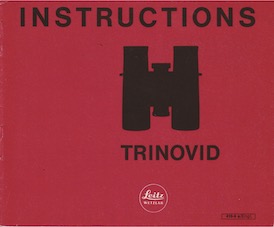 LEITZ TRINOVID INSTRUCTIONS illustrated instructions and warranty for the E. Leitz GmbH Trinovid mid and full size binoculars. Originally published by E. Leitz GmbH, of Wetzlar, West Germany in 1972. This is the English language publication, No. 410-6, printed in Germany also supporting their subsidiary Ernst Leitz Canada Ltd.
Company Seven has completed a high resolution scan of our original complete eight (8) page illustrated booklet, adding our cover page, that explains the use and warranty of the E. Leitz Trinovid mid size (24mm, 32mm and 35mm) and full size (40 and 42mm) series binoculars, and their accessories.
We prepared this and make it available to our customers for educational and entertainment purposes; this can be particularly helpful for owners acquiring an older Leitz Trinovid binocular for which there may not be support provided by the current Leica Camera GmbH. Content scanned from an original in our archives, and provided by Company Seven as an Adobe .pdf file for Acrobat Reader versions 7 or later.
Changes in September 2025:
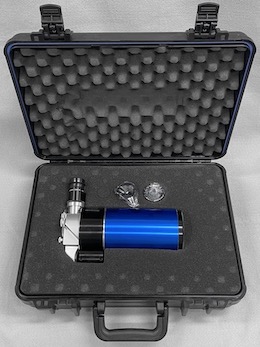 We have just completed another Questar field telescope, this is provided by Company Seven for a client who is in definite need of its capabilities.
Right: the new Questar Field Model telescope cased set with its provided accessories, undergoing routine quality control and final acceptance testing at Company Seven. This being handed over for our customer on 29 September 2025 (61,007 bytes)
Owing to production and staffing issues at Questar Corp. we at Company Seven continue to make no new Questar telescope commitments although by request we can wait list persons for future notification. We continue work towards completing some new Questar 7 instruments, likely to be completed over the next several months. Consequently, Company Seven is contacting those customers who have pending orders or are wait-listed in the queue with us.
Furthermore, Company Seven has concluded that the defunct Orion company will likely not be coming back as we knew it and so we are making available some of our last stocks of inventory by Orion Telescopes, this includes CFT80 (Carbon Fiber 80mm f/6 Apo) telescopes, German Mounts, and more.
These can provide you with an opportunity to acquire a good telescope at some savings, or find something that is no longer produced. These are on exhibit at our showroom in Laurel, Maryland.
Changes in May 2025:

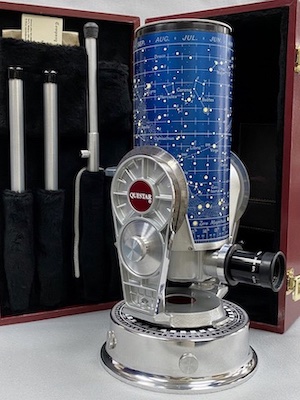
Right: a new Questar Standard telescope set, #25-xxxx-xx-xx complete in the recently introduced Pelican carry case, being readied for delivery at Company Seven on 9 May 2025 (113,144 bytes)
Note, owing to rampant plagiarism and copyright violations of our on-line Questar section by several 'E-Tailers' Company Seven had long ago discontinued writing about telescopes we offer for company7.com; so please contact us directly for latest specifications, choices, and pricing.
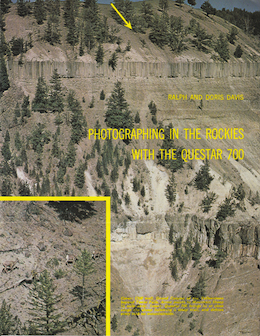 QUESTAR “Photographing In The Rockies With the Questar 700”, the complete four (4) page full color illustrated brochure featuring a series of color photographs of wildlife and scenery taken in the Grand Tetons and Yellowstone regions in the USA, over July.
The photographs in this brochure were taken with his Questar 700, the first production version of the patented 700mm f/8 catadioptric telephoto lens that were introduced in 1976. This demonstrates the kinds of results that one could expect to attain when safely photographing wildlife from some distance with the compact and relatively lightweight Questar 700 lens. However, the close up capabilities of the lens too are demonstrated as some objects were only 10 feet away. For comparisons, some animals (Elk, Moose, Mountain Sheep, Pronghorn antelopes, and a Yellow-headed Blackbird) and features including “Old Faithful” were photographed with a normal 50mm lens, then were again photographed but with the Questar 700 for comparison with stunning results! All photos were taken with KODACHROME 64 film, with a film speed of 1/125th second. Consider how in the late 1970’s, and through to the modern digital age, these were very good photos. As famous and popular as the KODACHROME 64 film was, we wonder at what results could be obtained today using the Questar 700 lens with a state of the art digital SLR camera with images processed with modern software.
Content Copyright 1976 Questar Corporation. Scanned copy of original from Company Seven’s Archives, hosted by permission. Download size with our cover sheet 5 pages, file size is 17,946,866 bytes (in Acrobat Reader “.pdf” format). This is available on request only for those of our customers who have made it possible for Company Seven to survive and prosper over the decades.
This article was gradually expanded to discuss the history about Square D as it pertains to the manufacture of these optics, history of the Kollsman Instrument Co., and this includes an overview of how the interwar United States government organized the production military binoculars, particularly models made for the US Navy, in the years leading up to World War II.
In March 2024 we again edited the article to include more information about the short-lived post war career of the SARD branded binoculars. This includes more information from our archives about SARD's efforts after the war to continue producing their 7x 50 Porro prism binocular for the consumer market, and their introduction of two compact models based on the Leman prism. Their compact prismatic models were marketed as the “SARD Sportsman”, a 6x 20 binocular, and the “SARD Theatre Binocular”, a 3.5x 15 model. Most of this manufacturing talent and competence have been lost in the United States as these kinds of jobs transitioned to Japan, then to China and other countries.
Efforts such as these are among the foolishly idealistic efforts by Company Seven's management to see to it that our small business matters to our community. Our work may help others who may come across relatively unknown items, such as these we explain at company7.com, to appreciate them better or even save them from being discarded.
Changes in February 2025:
Changes in March 2024:
Changes in January 2025:
Company Seven has scanned another original document in our archives, 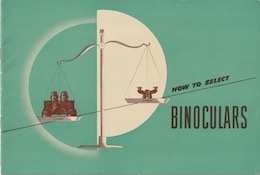 SARD “How To Select Binoculars”, the complete twenty-eight (28) page, plus cover sheet, illustrated brochure describing optical telescopes and binoculars, and how to select binoculars. This is the second edition published in November 1947 by Kollsman Instrument Division of Square D Company after World War II as they transitioned from manufacturing binoculars for the United States military, to production in peacetime for the civilian market. This is among the last of the SARD Kollsman literature that we have in our archives, before the company discontinued assembly and marketing of binoculars altogether.
Furthermore, we added the US Nuclear Regulatory Commission Office of Public Affairs document explaining Polonium-210 to our Staticmaster Notes & Interesting Articles section.
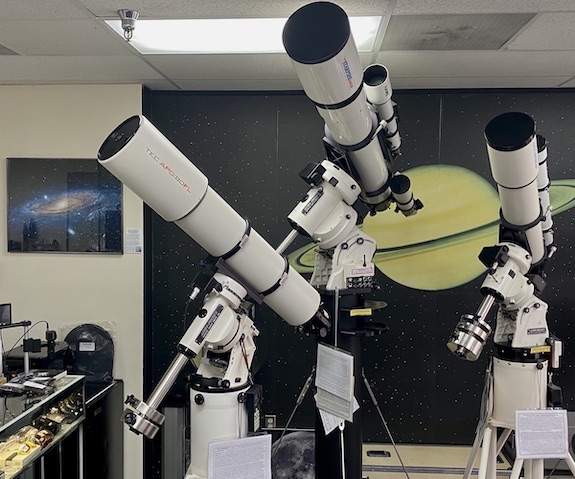
Above: part of Company Seven's showroom where we exhibit telescopes features our famous “Refractor Row” that includes some of the largest
In this perspective are (left to right): a TEC APO180FL (7.2 inch) f/7 Fluorite Triplet Apo on a Astro-Physics 900GTO mount with Particle Wave “Monolith” tripod,
transportable apochromatic telescopes ever made. For sense of scale, this area of our showroom has ceiling height of 9 feet (2.75 meters).
Astro-Physics 206mm EDF f/7.9 Apo (with "Stowaway" 90mm f5 finder, and a 90mm f/7 FL Apo photo-guide Apo telescope!) atop their 1600GTO mount
and portable pier, an Astro-Physics 160mm EDF f/7.5 Apo on their 1100GTO mount with Particle Wave “Pinnacle” tripod (105,008 bytes).
 Company Seven is now an authorized representative of the Telescope Engineering Company (TEC) product lines.
For more than twenty years Company Seven observed the development of Telescope Engineering Company telescopes. Not long after the turn of the millennium we actually were recommending people consider TEC as alternatives to some other Apos that simply were becoming unavailable new, and that were starting to command absurd premiums on the used market. By 2005 Yuri Petrunin, the founder of TEC, had refined the lens designs and production so that the TEC telescopes were no longer considered by us to be 'available alternatives', but were actually being recommended by Company Seven as excellent first choices, particularly of the larger models (about 13cm) that were not being made by most other reputable companies. In June 2014 our founder spoke with Yuri about some other matters, and Company Seven's endorsement of the TEC line came up in the conversation. Yuri invited us to refer customers or even offer the line; so we actually added TEC to our Product Lines listing even though we continued to refer sales directly to TEC in Colorado.
By January 2023 we formalized our relationship and Company Seven became a TEC factory authorized retailer as TEC products began to appear in our showroom exhibit. This makes Company Seven one of few, if not the only, showroom in the world with so much Apo experience also exhibiting such a diverse range of brands and sizes of first-rate Apo telescopes.
The story of Yuri Petrunin, founder of TEC, is another amazing story all on its own and so we include a discussion of him along with our Overview Of TEC And Their Products. As our efforts can be justified we expect to gradually add information and images about this exciting line of telescopes, best lusted after in our community for their APO140FL, APO160FL, APO180FL, APO 200FL, and APO250FL apochromatic refracting telescopes.
This month we worked to increase content of our illustrated article "Carl Zeiss - A History Of A Most Respected Name In Optics"; that is one of the oldest articles at Company7.com. We wrote about Dr. Max Paulÿ and his place in the establishment of their Astro Division in 1897; that would produce many famous large telescopes but that also produced their larger binoculars including the famous turret models, and even larger binocular telescopes. We expanded coverage and added illustrations about the history of Carl Zeiss Jena planetarium instruments, and the role of engineer Franz Dischinger (later Dr. Franz Dischinger) in devising the innovative lightweight concrete domes for these facilities. We added more information about their early binoculars. We discuss Dr. Rudolf Straubel, who in 1903 would become Carl Zeiss Jena’s Scientific Director, and about his integrity and loyalty to his family. This information is largely derived from literature in our Zeiss archives. We are also included more images of historic Zeiss items exhibited at our showroom.
We do this work for the love of conserving our history in optics, as much as to inform and entertain those friends and customers who have historically elected to patronize Company Seven.
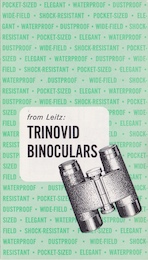 From LEITZ: TRINOVID BINOCULARS (introducing the E. Leitz GmbH Trinovid Binoculars). Originally published by E. Leitz GmbH, of Wetzlar, West Germany in 1963. This is the English language publication, No. 1500, printed in Germany.
Moderate resolution scan of complete six (6) page illustrated booklet introducing the new Leitz Trinovid series of consumer oriented binoculars and their accessories. This also includes the US Prices list. The original three TRINOVID binocular models are featured and described: the TRINOVID 6x 24 (PN 40201, 40202), TRINOVID 8x 32 (PN 40206, 40207), and TRINOVID 10x 40 (40211, 40212). These innovative binoculars were highly regarded. Their features, accessories, and guarantee are explained as well.
The TRINOVID 6x24 was discontinued in 1965, while the other two models were produced until 1975 when replaced in 1974 by the improved 'B' series models. By 1981 the choice of the original leather clad remained, but a choice of rubber armoring (BA series in black or green) were also added. The Leitz Trinovid B/BA were manufactured through 1990. Their features, accessories, and guarantee are explained as well.
The handy form factor was so popular and so many people treasured their old Leitz Trinovid that Leica Camera, AG instituted a program to update them with 21st Century optics and features, and in September 2017 announced return of the original form factor as the improved Leica TRINOVID 7x 35B, 8x 40B, and 10x 42B. These binoculars commenced shipping in the Fall of 2020, by some being referred to as the Leica 'Classic' or even 'Retrovid' models sold by Company Seven.
Article prepared for educational purposes, is helpful in comparing the technologies of the era compared to those of today and following the history of one of the world’s most important optical companies. Content scanned from an original in our archives, in moderate resolution and provided by Company Seven as an Adobe .pdf file for Acrobat Reader versions 7 or later.
Scanned another document in our archives to host at our on-line archives, this title 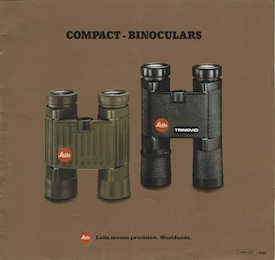 COMPACT - BINOCULARS: Leitz Means Precision Worldwide (introducing the E. Leitz GmbH 8x20BC and 10x25BC/BCA Compact Binoculars), published April 1982, English language. Originally published by E. Leitz GmbH, of Wetzlar, West Germany. Publication No. EL / 410-027, printed in W. Germany.
Moderate resolution scan of complete eight (8) page color illustrated booklet describing the Leitz BC and BCA series of consumer oriented compact binoculars and their accessories. Both BC series models, the 8x 20BC and 8x 20BCA TRINOVID (Model 40305 and 40307), 10x 25BC and 10x 25 BCA TRINOVID (Model 40306 and 40308), were announced in April 1982. The roof prism binoculars shown in this brochure were available leather covered in black or in green rubber armored configurations. Later these were offered in the choice of black rubber armored too. Some limited edition models have been made featuring special finishes, coverings or materials. Their features, accessories, and ten year guarantee are explained as well. These were manufactured bearing the Leitz trade name through 1990, since then these are made bearing the Leica trade name. This complements the document from 1978 introducing their first Leitz Trinovid C compact binoculars which we scanned and make available below.
Article prepared for educational purposes, is helpful in comparing the technologies of the era compared to those of today and following the history of one of the world’s most important optical companies. Content scanned from an original in our archives, in moderate resolution and provided by Company Seven as an Adobe .pdf file (8,338,694 bytes) for Acrobat Reader versions 7 or later.
Moderate resolution scan of complete six (6) page color illustrated booklet describing the Leitz C series of consumer oriented compact binoculars and their accessories. Both C models, the 8x 20C TRINOVID and 10x 22C TRINOVID, were announced in April 1975 and manufactured through 1982. The roof prism binoculars shown in this brochure were available leather covered (Models 403xx, and 403xx), with a 10x 22C SAFARI in green leather (Model 403xx) configurations. Their features, accessories, and ten year guarantee are explained as well. These C series compact binoculars were replaced in 1983 by the improved 8x 20 BC TRINOVID and 10x 25 BC TRINOVID models, that later were also made available in rubber armoured configurations.
Article prepared for educational purposes, is helpful in comparing the technologies of the era compared to those of today and following the history of one of the world’s most important optical companies. Content scanned from an original in our archives, in moderate resolution and provided by Company Seven as an Adobe .pdf file (25,832,739 bytes) for Acrobat Reader versions 7 or later.
Changes in November 2019:
Scanned another document in our archives to host at our on-line archives, this title 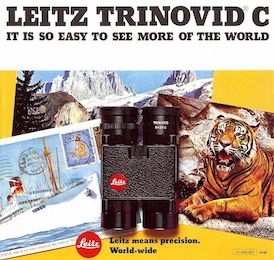 LEITZ TRINOVID C: IT IS SO EASY TO SEE MORE OF THE WORLD (E. Leitz GmbH 8x20C and 10x22C Compact Binoculars), published Sept. 1978, English language. Originally published by E. Leitz GmbH, of Wetzlar, West Germany. Publication No. EL / 121.410-017, printed in W. Germany.
The photographs were taken with his Questar 700, a catadioptric 700mm f/8 telephoto lens, with the then recently released Kodak Ektachrome 200 ASA slide film. This shows the kinds of results that one could expect when safely photographing wildlife from some distance with the compact and relatively lightweight (about 4 lb.) Questar 700 lens. Wildlife shown in the brochure include: Lions, Cheetah, Eland, Gazelles, Giraffes, Zebra, Hippopotamus, Wildebeest, Impala, Dik-Dik and other mammals. Also shown are birds including a Gray Crown Crane, Augur Buzzard, and more. Some of the animals were photographed in repose while some were captured while in motion showing what is possible when photographing even at f/8.
Changes in July 2019:
Updated our Questar Notes & Interesting Articles Index page to include  QUESTAR IN KENYA On Safari With The 700, the complete six (6) page full color illustrated brochure featuring a series of color photographs of wildlife taken by Eugene J. Cohen, M.D.. during one of his annual visits to Kenya.
Changes in September 2018:
Updated our Company Seven "C-VII Journal" Notes & Interesting Articles Index page to include 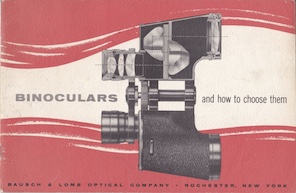 Bausch & Lomb Binoculars And How To Choose Them, Aug. 1955, the complete thirty-six (36) page illustrated booklet describing the Bausch & Lomb binoculars, monocular, and two spotting telescopes. This is among the last of their sporting optics catalogs published while their products line still resembled those they had made for some decades in the United States. Though soon after the war they and other manufacturers commenced exporting U.S. based jobs to Japan, this catalog does explain "Every Bausch & Lomb Binocular is built to precision-instrument standards to give life-time service and satisfaction- and it is the only binocular of American manufacture on the market today."
Changes in July 2018:
 Bausch & Lomb Binoculars, 1940 catalog and price sheet, the complete forty (40) page illustrated booklet describing the Bausch & Lomb binoculars and field spotting telescopes. This shows the product line as it was just before the company transitioned to full time war production, this with our 1923 and 1934 catalogs that we host, helps us to better understand the development of their binoculars over this era.
 Carl Zeiss Jena Prism Binoculars pamphlet and price list of 1937. Published by by Carl Zeiss, Inc., then the United States distributor for Zeiss Jena products.
Changes in June 2018:
Right: prototype of Company Seven’s Riser, an optional solution improving elevation clearance for the Questar Tristand or Astropier, shown installed (17,105 bytes).
The Sun will rise to it’s highest elevation in the sky near noon each day, in our Washington D.C. area for example on the day of the Summer Solstice the Sun will rise up to 74 degrees above the horizon. In June of 2017 Mr. D. Illig, one of our local clients, was preparing to image the coming August 21 Total Solar Eclipse of the Sun. He noticed that when his large Canon EOS digital SLR camera was attached to his Questar 3-½ telescope, the curved northern tip of the Tristand Head Elevation Axis hindered his pointing the Questar 3-½ telescope high enough to reach the Sun.
We have been offering the elegant Tristand, and a taller version marketed as the Astropier too, for some decades with only one other client ever before contacting us about experiencing this limitation. For that client Company Seven developed a cylindrical extension that could be attached onto the Tristand Head platform, this elevated his telescope and provided enough clearance so that he could photograph the Sun at any time of the year from his location. Given the increasing bulk of DSLR cameras, and also motivated to help Mr. Illig, Company Seven revised our prior solution and in July 2017 introduced our revised Riser.
Company Seven’s Tristand Head Riser allows a Questar 3-½ telescope with a larger camera or other payload attached to point up to higher elevations of the sky. The construction of Company Seven’s Tristand Head Riser fully matches the material and finish of the Tristand furthermore, this does not compromise rigidity or stability of an attached telescope.
Changes in July 2017:
) Company Seven announced the Questar Tristand Riser. This is our new precision machined accessory that increases the payload elevation clearance capacity for the fork mounted Questar 3-½ telescope when the set is employed on either the Tristand or Astropier.
Company Seven announced the Questar Tristand Riser. This is our new precision machined accessory that increases the payload elevation clearance capacity for the fork mounted Questar 3-½ telescope when the set is employed on either the Tristand or Astropier.
Click on image to see enlarged view (72,480 bytes).
Changes in April 2017:
, manufactured by B&L under license). This also features photographs of their telescopes including a B&L 11 inch diameter f/15 refractor on their German Equatorial Mount in their new factory observatory and elevating floor, of scenery and architecture of that time.
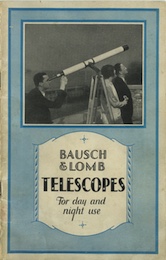 Bausch & Lomb Telescopes: for day and night use, catalog of 1929
The catalog goes on to explain how the B&L telescopes are available for terrestrial applications while larger or more sophisticated models were made for uses involving astronomy. Pages detail and illustrate their 60mm, 80mm and 102mm telescopes, include specifications, and itemize included accessories. The prices of several popular models of telescopes and accessories are included however, given these costs these certainly were sold only to those persons of some means, or organizations since the price even for a small 60mm telescope was the equivalent of several months of an average American’s home mortgage payments. Their equatorially mounted telescopes appear to have been marketed here primarily to educational organizations, with larger models for universities seeking to advance their educational programs and make a statement by funding their own large astronomical observatory. One could order a complete telescope optical tube assembly with or without mount, or order a telescope objective lens set alone; this catalog lists 25mm up to 152mm (6 inch) objectives ranging in price from $12.00 up to $400.00 though the larger 127 and 152mm objectives being made to order. Among the aspects that we at Company Seven found most interesting were the explanations of the provided accessories and optional accessories too including: various designs and focal lengths of available eyepieces, their zenith prisms and the triple revolver for astronomy and the image erecting prisms for terrestrial work, sun glass and ray filters, and the Herschel Eyepiece (Herschel Wedge) for studies of the Sun. Eyepieces explained include Huygenian models in focal lengths of from 8.5mm up to 60.89, and Orthoscopic models of from 6mm to 32mm focal length. Tripods, stands, driven setting circles for German Equatorial Mounts, and other items are mentioned.
Content scanned from original in our archives in moderate resolution and provided by Company Seven as an Adobe pdf reduced size file (1,424,770 bytes including cover sheet). This is available on request only for those of our customers who have made it possible for Company Seven to survive and prosper over the decades.
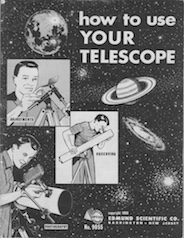 Edmund Scientific how to use YOUR TELESCOPE, 1959
Contents include: The Sky Show explaining the major objects (Sun, Moon, and Planets) and other celestial objects visible in the sky, How To Use Your Telescope including how to select a telescope and what you may expect to observe with it, explanations of the Equatorial Mount, Telescope Arithmetic, What Eyepiece is Best?, How to Find Sky Objects including explanations of charts and aids, Observing Hints, Observing the Planets, Observing the Sun, Selected Sky Objects, Collimation and Adjustments, Photography with Your Telescope, Target Moon, and Splitting the Doubles.
Publication is No. 9055 in the Edmund series “Popular Optics Library”. Contents Copyright 1959 by Edmund Scientific Company. All rights reserved - reproduction, or editing, or distribution without express consent is forbidden. Used by permission of the original company management, back in the mid 1980’s when Company Seven was an authorized retailer for Edmund Scientific Company. Content scanned from original in our archives in moderate resolution and provided by Company Seven as an Adobe pdf reduced size file (12,271,907 bytes including cover sheet). This is available on request only for those of our customers who have made it possible for Company Seven to survive and prosper over the decades.
An interesting and educational read, even as a refresher for those who already are familiar with the subject. Contents include: a catalog of 28 publications in the POL and “How To Make It” series. Then it goes into explaining: Solar Time (Apparent Solar, Mean Solar, Local Mean, and Standard), time zones, Universal time, applications of time, time conversions, Sidereal time, positions of stars and the telling of time by the stars, how to use setting circles of a telescope
Publication is No. 9054 in the Edmund series “Popular Optics Library”. Contents Copyright 1958 by Edmund Scientific Company. All rights reserved - reproduction, or editing, or distribution without express consent is forbidden. Used by permission of the original company management, back in the mid 1980’s when Company Seven was an authorized retailer for Edmund Scientific Company. Content scanned from original in our archives in moderate resolution and provided by Company Seven as an Adobe pdf reduced size file (10,849,031 bytes including cover sheet). This is available on request only for those of our customers.
Changes in March 2017:
 Bausch & Lomb Stereo-Prism Binoculars, catalog of 1923
This month we scanned another original document in our C7 Collection Items Articles & Archives. This is the complete twenty-eight (28) page illustrated booklet describing the Bausch & Lomb prism binoculars. You might know them today for making sunglasses and contact lenses, but decades ago Bausch & Lomb, established in Rochester, New York, was a manufacturing powerhouse: a preeminent maker of raw optical glass, of binoculars, camera lenses, and other optics too. They, along with nearby Kodak and other manufacturers, set the tone for innovation and development of new technologies in optics and photography among other fields. This catalog was published in the post “Great War” era, at the time Bausch & Lomb Company marketed binoculars to consumers for sporting, birding, boating, and other pursuits.
Bausch & Lomb Stereo-Prism Binoculars, catalog of 1923
This month we scanned another original document in our C7 Collection Items Articles & Archives. This is the complete twenty-eight (28) page illustrated booklet describing the Bausch & Lomb prism binoculars. You might know them today for making sunglasses and contact lenses, but decades ago Bausch & Lomb, established in Rochester, New York, was a manufacturing powerhouse: a preeminent maker of raw optical glass, of binoculars, camera lenses, and other optics too. They, along with nearby Kodak and other manufacturers, set the tone for innovation and development of new technologies in optics and photography among other fields. This catalog was published in the post “Great War” era, at the time Bausch & Lomb Company marketed binoculars to consumers for sporting, birding, boating, and other pursuits.
To make note of this we have updated the artwork at our home page to reflect this.
Changes in November 2016:
Right: Lunt SUNocular solar binoculars shown at Company Seven, note the opaque solar filter elements over the objective lenses (79,574 bytes).
The innovative SUNocular does at first glance appear to be a conventional central focus roof-prism binocular however, the SUNoculars incorporate glass solar filter elements that so reduce the amount of light passing through that these are suitable solely for examining intensely bright objects such as the Sun. These filters are an integral component that cannot be removed (or lost) this the SUNocular cannot be employed for the observation of terrestrial objects. The light from the Sun is reduced to a comfortable level for observing, while harmful ultra-violet and infrared components of that light are completely and safely blocked. The full size SUNocular is so compact and useful that Company Seven is stocking this, ordering the small 6x SUNocular-Mini only by request. This article profiles the SUNocular 8x model.
Changes in January 2017:
 On 8 January 2017 we celebrate years as a licensed business while defining competence and integrity in our community, with more than thirty-three (32) of these years at our Laurel, MD showrooms. The original telescope showroom opened 1 October 1984, we outgrew that and relocated in 1 October 1986 to our present location on Cherry Lane Court.
telescopes, featuring a 3.5 inch diameter focuser these are the successor to the prior Astro-Physics 13cm EDF Gran Turismo telescope. Invitations to those customers of Company Seven who registered on our waiting lists commenced going out.
) The SUNocular and SUNocular-Mini binoculars were introduced by Lunt Solar Systems to provide the user with a compact, convenient, and affordable means of safely observing aspects the Sun including Sun Spot activity (magnetic storms) or Planetary Transits. These were developed specifically with the impending Total Solar Eclipse of August 2017 in mind where millions of people across much of the USA will be able to observe this rare even.
The SUNocular and SUNocular-Mini binoculars were introduced by Lunt Solar Systems to provide the user with a compact, convenient, and affordable means of safely observing aspects the Sun including Sun Spot activity (magnetic storms) or Planetary Transits. These were developed specifically with the impending Total Solar Eclipse of August 2017 in mind where millions of people across much of the USA will be able to observe this rare even.
Click on image to see enlarged view (322,960 bytes).
Changes in April 2016:
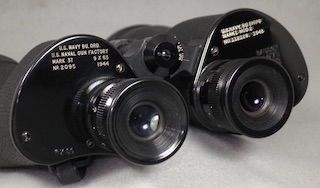
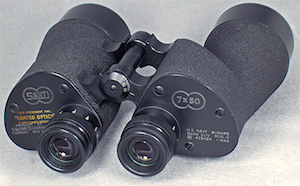
We were pretty excited about finding a Mark 37 binocular in good condition because:
The excitement needed to be shared with those who have helped to keep Company Seven around for well more than three decades, and so we elected to write about the U.S. Navy Mark 37 binoculars too. This article will contain some informational overlap with that content in our previously published article about the U.S. Navy Mark XLIV 7x 50 SARD binocular. We have worked to minimize overlap except where it helps either article stand on it’s own.
In light of the significant contributions of optics to the war, we exhibit our Mark XLIV alongside other US Navy optics at our Laurel, MD showrooms and we wrote an article for our Library outlining the 7x 50 binoculars issued during World War II by the US Navy Bureau of Ships (BUSHIPS).
Changes in May 2016:
 This month Company Seven pulled more information from our archives for scanning. This latest document is even more interesting to read that we might have imagined, it is the
  With some of the content in our article dating back to 1994, when slow dial-up Internet access was the norm for most readers, the article was text heavy because illustrations were by necessity kept to a minimum. Over the decades we have and will on occasion add this or that illustration of items in our museum collection to break up the monotony of text, or make corrections (with much gratitude to contributors), clarify and expand information about content as we pull more information from our own archives. It was never our intent to write a comprehensive and all encompassing history of Zeiss, that would require volumes to do it justice, but rather to show why we at Company Seven were and remain in awe of the company achievements.
 Changes in February 2016:

The spectrometer (or spectrograph) is a device used to observe or with the aid of a camera or other equipment to record spectra; spectroscopy is the use of a spectrometer to perform chemical analysis of the radiative energy involved in the interactions at the source of that energy. Sometimes equipment can be optimized for specific applications, for example the spectrohelioscope was devised to study the spectrum of the Sun. Shelyak Instruments are well at home in Universities and at government research laboratories. However,
Shelyak is now distributed by Company Seven. We are about the longest lived of the few remaining astronomical instrument specialty companies serving the professional and amateur communities. You can browse our introductory article about Shelyak Instruments to read an overview of the product line, but if you visit our Shelyak “Notes and Interesting Articles” section there you will find a number of interesting resources and presentations about spectroscopy. Our site content about Shelyak and spectroscopy will be notably expanded in time, while the Shelyak Instruments company site at http://www.shelyak.com/?lang=2 too hosts many many more articles, several that C7 hopes to co-host in time.
Changes in January 2016:
To make note of this we have updated the artwork at our home page to reflect this.
Changes in November 2015:
Changes in September 2015:
Changes in September 2014:
Changes in August 2014:
Changes in July 2014:
Changes in April 2014:
This new filter is described in our web page section about production DayStar Hydrogen Alpha Filters. One of the first production QUARK 0.7Å filters will be on hand at Company Seven by April 19 for use at our 'Solar Saturday' sun observing sessions, so you may visit Company Seven to see one in use for yourself. Company Seven has been accepting orders for the QUARK since 1 February, while this new product was announced to the public later on 1 April 2014. Contact Company Seven, preferably by E-Mail to order yours or to learn more about this interesting and fun accessory.
Changes or news in February 2014:
Changes in January 2014:
To make note of this we have updated the artwork (shown at right) at our home page to reflect this.
Left: the serial number 152 on the Model 2001 telescope now on display at Company Seven (67,889 bytes).
For Company Seven this could be no average Model 2001, we had to find something more interesting than the other hundred thousands made to date: we now show telescope Serial No. 152. This was made very early in the first production lot; this was back when such things were actually made in the USA while now all new Astroscans are made in (take a guess) China. This telescope replaces 2075, our previous old-timer on display. This 102mm clear aperture 445mm focal length f/4.2 Newtonian telescope (the lens at front is a flat glass window) was completely disassembled, cleaned and conserved. Other than making an exact duplicate charcoal polyurethane foam disc that backs the Primary Mirror to replace the original spalling foam, we did not replace any original components but cleaned and restored the entire assembly. Nor did we see any need to strip and recoat the optics after a professional cleaning, but left them original. SN 152, now fully assembled and collimated at Company Seven, is now on display at our showroom. Our team devoted a ridiculous amount of technician and optical bench time doing this - but nobody ever before accused Company Seven of operating like a business. In time we may host an illustrated article about these telescopes at company7.com.
The Astroscan is quite a compact simple to use arrangement, and yet is a comparatively ruggedly built portable telescope. These were introduced in September 1976 with a goal of selling eight hundred, but by Christmas more than two thousand of the first three thousand sold had been delivered. These helped many newcomers enjoy their first exposure the hobby, and were a good choice for some who simply sought a more compact second wide field telescope. Astroscans are at their best introducing those who want to learn their way around the night sky, observe the Moon and other brighter objects. These remained especially popular while Company Seven sold them throughout the Comet Halley era of 1984-1985 though we discontinued selling them soon after when production shifted to other facilities. Furthermore, with the introduction of reasonably well made imported Newtonian telescopes with Dobson-style mounts (such as our Orion compact six-inch StarBlast 6), the Astroscan has not provided as great a value for most of our customers as it once had.
Changes in May 2013:
These were introduced in September 1956, and are among that class of telescopes that the more experienced amateur or a small school aspired to own from when it was introduced to well into the late 1960s before more compact alternatives came onto the market. We rate the Criterion Dynascope 8" f/7.7 Custom Deluxe as an intermediate level amateur observatory or 'transportable' telescope. The optical tube is physically quite long as it is optimized for high resolution work. The Dynascope incorporates interesting ideas including a figure 8 Secondary Mirror holder (Spider) that eliminates the diffraction spikes often seen on bright starts with conventional four vane Spiders. It has a relatively small (3.5%) central obstruction and smoothly figured mirrors that provide a view that is bright, much sharper and contrasty than most modern 8" (even than some 10") reflecting telescopes. Thus it clearly reveals the major features of Venus, Mars, Saturn, Jupiter, the Moon, Sun (with safe filter), and double stars separations for example. From darker observing sites it can reveal the entire "Messier" and many "Caldwell' cataloged deep sky objects, showing distinct characteristics of popular galaxies, nebulae, star clusters, and more!
The heavy duty German Equatorial Mount (Model CMD68) rigidly supports the OTA optical tube. Its motorized Clock Drive (CED72) and Slow Motion Dec. Axis control (SM 7203) facilitate the tracking of celestial objects across the sky and with good enough precision for astrophotography or other studies. The set with its 65 inch long OTA weighs about 160 lbs., is it any wonder such telescopes were obsoleted by more compact (even if in several ways optically inferior) telescopes such as the Celestron C-8 introduced in 1970.
In time we may host an illustrated article about these telescopes, just as we have written about its smaller cousin the Criterion RV-6 Dynascope, these introduced many of us to visual astronomy.
Changes in April 2013:
Company Seven has one last new 1200GTO German Equatorial Mount and one new
Changes in March 2013:
The DVD is authored to be read only by a personal computer, not by a conventional DVD video player, and as such has no Region restrictions as do conventionally authored DVDs. This content includes:
This item is so well proved and received by those in Europe who can order it directly that Company Seven has elected to distribute this for the Americas. Customers in Europe can continue to order direct from the authors in the United Kingdom. Furthermore, this is the first item that we will allow to be ordered on-line directly from Company7.com. Deliveries will commence at the end of this month and you will be able to buy a copy at our showroom in Maryland too.
Looking up into the Heavens on a clear night under a dark sky, we can easily fool ourselves into thinking that the brightest stars we see are those closest to us. The reality could not be more different! In fact, 19 of the 25 closest stars to the Sun are invisible to our naked eye, and many are actually so faint that even with the modest equipment owned by most amateur astronomers, they can be supremely difficult to find. "Eyes To See: Observing the Nearest Stars" takes the reader on a one-year guided tour through the regions of the Milky Way galaxy closest to our own solar system, concentrating on practical hints at observing this region for one's self.
This is another of those wonderful books that are difficult to find in a store. Company Seven found it to be such a practical and enjoyable read and reference work, that is also thought-provoking on several other levels too so that we wish to share this with our friends. We will make a special effort to stock this title, and to make it available as a .pdf title for those who seek such portability and convenience.
Changes in February 2013:
Changes in January 2013:
Changes in November 2012:
Changes in October 2012:
We have dramatically beefed up our book selection with many of the most recent titles that pertain to: observing and imaging the Sun, latest knowledge about features on and within the Sun (including the sunspots, prominences, and the solar tachocline), as well as some reprints of much older books that demonstrate the history of solar studies and the perceptions of those who preceded us in solar studies.
The sale applies to all current production eyepieces* (including new Delos), Barlows, Powermates and Paracorr. Commencing Monday 1 October through Wednesday 28 December 2012, save ten percent off our normal pricing on all current production TeleVue eyepieces and most auxiliary optics. Yes, this is a factory authorized sale that includes all the latest production TeleVue Ethos and Ethos SX, and Delos eyepieces. This will include the newest Delos 3.5, 4.5, 8.0, 12, and 14 mm eyepieces that will be introduced later this month. The sale also includes all the TeleVue Nagler series (Type 4, Type 5, Type 6) eyepieces including the Nagler Zoom, Panoptic, and Plossl eyepieces. Also included in the sale are the TeleVue coma-correcting visual and imaging Paracorr 2 lens, and their Barlow and Powermate lenses.
*The Radian eyepieces are not included in this sale as they are being gradually phased out, and stock remains only of some focal lengths.
In addition to describing these articles in our Library index, we also mention them here with the hope that the information may more quickly be picked up by the Search Engines for dissemination:
Changes in August 2012:
The 1600GTO replaces the 1200GTO in the product lineup, featuring 1. an increased payload handling capacity of up to about 200 lbs. to manage RC telescope with working payloads up to about 20 inch aperture for example, with 2. the option to have new or added later one or both 'absolute' encoders - particularly beneficial for remote observatory control, and 3. the Periodic Error spec of 5 arc seconds (+/- 2.5 arc sec.) is the maximum native mechanical error inherent in the mount's RA axis WITHOUT any software correction. In order optimize performance even further, the factory employs a special version of Ray Gralak's PEMPro developed specifically for their test equipment so that they will generate a unique PE curve for each mount and program it into each GTOCP3 Control Box. Simply use the Keypad or your Astro-Physics software (ASCOM V2 driver, PulseGuide or APCC) to turn the PE Correction "on" and you will see results significantly better than our published 5 arc second spec without additional PEMPro runs! However, you may use PEMPro to further refine your PE, if you chose to do so. The 1600GTO features the capability to align at anywhere between 0 to 78 degree latitudes without an optional Wedge; that spans from Antarctica to the arctic circle! The 1600GTO head has extensive milling to keep the basic head weight to about 115.5 lbs (52.5 kg). The head will stand about 4 to 4-1/2 inches taller (depending not the selected Park Position) than the 1200GTO, and most hardware options remain interchangeable. There are new, larger 7.65 inch wide "P" series Saddle and 23 inch long Dovetail Plate choices coming available, and a new larger 24 lb. Counterweight. Another nice aspect of the 1600GTO is that the Rotating Pier Adapter, formerly an option for the 1200GTO, is standard with the 1600GTO.
For these products we will first refer to our waiting lists, sending invitations to notify people who have registered, then we will assign spare production slots to new customers. Accordingly we have updated our Astro-Physics Telescope and Mount Availability information page and commenced sending out invitations to those lucky people. Company Seven has one last new 1200GTO German Equatorial Mount (from the last production lot) on static display at our showroom. We have not yet decided whether or not to keep it on display and add the 1600GTO alongside it for comparison, or sell the 1200GTO to make room for the 1600GTO. Of course we will prefer to give priority on assigning this last 1200GTO to those who have historically chosen to buy from Company Seven. Either way, the display will continue to be impressive and unrivaled. It is possible that we may be receiving some 1200GTO mounts in trade or on consignment as some customers will want to upgrade their observatory, so this may help customers seeking a more 'transportable' alternative to the 1600GTO.
Changes in June 2012:
Changes in January 2012:
We thank those customers and friends who have been astute and demanding enough to choose to buy from Company Seven, and to otherwise support our goals. It has been a true pleasure and privilege to have made so many friends around the world.
In January we resume updating articles at our Internet site.
We started thinking about how the article might be interesting to those in Japan who work at Nikon or others who are fond of Nikon or optics history, so we employed the on-line Google Translator to convert the text to Japanese Kanji and host it here. We have no idea how well this translated into Japanese, so we apologize in advance if our efforts have set back US-Japan relations by 50 years.
Changes in November 2011:
There was an unusually good omen for the new observatory. As the date of the ribbon-cutting approached the days were more and more cloudy until on the day of the event the coverage of clouds was complete from horizon to horizon. When the event commenced at 7 pm the skies were still completely cloudy. At 8:38 pm, as the ribbon was cut opening the observatory dome, someone called out "a star". We looked to see a small area of cloud cover had thinned just enough to reveal Jupiter, but no other stars or Moon across the sky could be seen. We powered up the telescope and its control systems, opened the dome, then turned the telescope onto the giant planet - now about 49 Arc. Secs. in diameter and about as well positioned as it gets for us on Earth. Amazingly enough, Jupiter remained visible for all to see. Even though the facility had only one eyepiece, a TeleVue 41mm Panoptic providing only a modest 119x, over the next twenty minutes or more Jupiter put on a great show and all who walked up the steps to the eyepiece of the telescope and enjoy that sight.
Accordingly we have updated our 'MCCM' Observatory Project index page to reflect the announcement and progress of the plans so far.
Changes in October 2011:
Changes in August 2011:
Right: Lunt 80 DSII alongside a Lunt 60 DS Hå telescope atop optional German Equatorial Mounts observing the Sun by Company Seven's showroom (130,026 bytes).
These Lunt telescopes are purpose built solely for studies of the Sun. Our new LS80 model is for display and joins our inventory of Daystar Hå filters too for Saturday solar observing sessions at Company Seven. This telescope provides an 80mm aperture with an 18mm diameter blocking component in the diagonal at rear. These systems filter sunlight so that one sees the Sun as a deep red disc contrasted against the blackness of space. The image of the Sun is brought to focus at a point beyond the focuser. An eyepiece for viewing or a camera for photography can be attached to the focuser.
The filter components are so precisely made that any change of ambient temperature alters the bandpass, so in order to compensate, a piston attached to the filter housing is adjusted to 'pressure tune' the bandpass by dialing in or out to bring the filter to its best performance setting. With a primary filter alone the bandpass is between 0.7 to 0.8Å (Angstroms) centered at 653nm; so details on the surface of the Sun and surrounding prominences are seen. Ours is among the first of the new Lunt DSII series telescopes indicating 'double stack at the rear' so one can attach a second filter component in the black housing just behind the red collar to further narrow the bandpass to 0.5Å or less. This provides added contrast of details on the Sun's disc and of the more massive ejections and prominences, at times appearing three-dimensional. These are rugged and compact telescopes, easy to travel with. We placed the LS60 alongside the LS80 with 1.25 inch diameter diagonal attached for scale, note the focusers are 2 inch 'FeatherTouch' models with braking made by Starlight Instruments.
In time Company Seven may develop new sections in our web site featuring the Lunt and Starlight Instruments products at least for as long as we do not provide so much content that it tempts 'E-Tails' to steal our content.
Right: Optical Guidance Systems 32 inch Ritchey-Chrétien telescope on OGS140 Fork Mount at George Mason University, in Fairfax, Virginia on 27 July 2011 (26,729 bytes).
The purpose-built cylindrical observatory building with 6 meter diameter Ash Dome housing the new telescope were designed by GMU and their contractors.
It was the early discussions for this task, and our offer to acquire and refurbish the Biosphere Observatory telescope as one of the options, that first brought that OGS 24 inch telescope to our attention. It was in time acquired by our owner, and activated late in 2010 nearby in Maryland. So now GMU's telescope is larger than ours by 0.2 meter, and their dome is 1 meter larger in diameter than our Ash Dome. We'll do better with our next telescope - the 'MCCMOv2.0'!
Changes in July 2011:
The NP101 and NP101is are the first TeleVue 4" Apos that we rate as the equal of the worlds best in optics and mechanics featuring upgraded focuser that not only manages heavier payloads, but incorporates the Feather Touch® two speed, 9:1 geared focuser pinion assembly. This focuser accepts optional motorized control permitting local control of focus by the user, remote control via wired or wireless, or automated focus control by computer. While the handy NP127is remains the fastest, flat-field Apo telescope in production - also incorporates the Feather Touch® focuser.
Since TeleVue has made numerous changes to their telescopes over the past year we updated our TeleVue Imaging System Accessories index page so that our customers will be able to better understand which accessory is compatible with which model of current and older discontinued models as well.
Changes in June 2011:
Changes in May 2011:
The caption for the article might be "Our Unitron Has More Stuff Hanging Off It Than Your Telescope".
Prayers may comfort the souls of the departed, but donations of money will more immediately comfort the survivors and might save lives too. We urge you to contact legitimate relief organizations and to contribute, any amount will help. You may donate to assist Japan through this American Red Cross on-line link
Above: Logos of American Red Cross, Japanese Red Cross, International Red Cross
Changes in February 2011:
Changes in January 2011:
In this article we think back to the 1970's and 1980's when Nikon dominated professional 35mm single lens reflex (SLR) camera and lens technology, and their logo was known to almost anyone world-wide. This was a time when a corporation like Nikon would put its best minds to work at developing truly amazing products in addition to those that simply made good commercial sense. Their innovations include producing the the world's first high performance 200mm f/2 telephoto lens, and the world's first and only high performance 300mm f/2 ED IF telephoto lenses, the cousin of the world's first 400mm f/2.8 ED IF lenses. Here we provide a well illustrated overview of the history and development of these lenses, three variants of which are described in this article, complete with Patent papers and other information. We will most likely add more information to the article over time as new information comes to light.
Yeah, we know Nikon has not made these lenses for years and probably never will do so again, so this has nothing to do with Company Seven earning any income or paying bills. We put great effort to researched, collect, and conserve these lenses because of our respect for the achievements by Soichi Nakamura and Kiyoshi Hayashi. Furthermore, we like to inform and entertain our customers who make it possible for us to stay in business.
Changes in December 2010:
Changes in November 2010:
Changes in October 2010:
Our overview of this telescope is now on line at TeleVue NP127is 2010 Model. Feel free to contact Company Seven for additional details, or to place an order for delivery as these become available.
Changes in September 2010:
The first item we feature is the famous Nikon Rayfact UV-105 F4.5 Lens that is offered in the Americas through Company Seven by special order. This lens bears the 'NikonRayfact' designation, but it is a current Nikon production lens that replaces the original UV-Nikkor (PN 1453) that was introduced in September 1985. The UV-105 lens is an exceptionally sharp 105mm f4.5 conventional lens with macro (2:1) capability too. However, this lens is most acclaimed for its usefulness from 220nm in the ultraviolet up through the visual spectrum and into the near IR at 900nm. This this is a preferred lens for forensics, medical studies, electric discharge studies, research, or for the more dedicated amateur who seeks to explore portions of the world invisible to the eye. This lens is provided with the Nikon F mount and as such can be attached onto any Nikon SLR film or digital camera, or onto a Bellows or other fixtures. We will gradually describe more and more of the limited production Nikon products as we develop our Nikon section on line.
This Nikon UV Lens is complemented by our afused silica Long Distance Microscopes that can provide resolution in the visual and UV spectrum down to the sub-micron level.
Changes in August 2010:
Much has been going on at Company Seven over the recent months, but since we are foremost showroom oriented and not primarily an 'E-tail' based shop and since our people have been spread thin overseas on other work we do, we have not been able to provide much attention to our Internet site as we would like to. You can contact or visit our showroom to see these, and in time we may post detailed illustrated reviews of these 'hot' new products on line. But for a taste of some of our most favorite recent news here goes:
The Pricing of the instrument set is $17,500.00. We have updated our availability information for this product on line reflecting we are accepting orders for deliveries starting in Fall 2010 and continuing into 2011.
The Pricing has not changed. We have updated our availability information for this product on line reflecting we are accepting orders for deliveries starting in late October and continuing into the Fall 2010.
Changes up to July 2010:
Much has been going on at Company Seven over the recent months, but since we are foremost showroom oriented and not primarily an 'E-tail' based shop and since our people have been spread thin overseas on other work we do, we have not been able to provide much attention to our Internet site as we would like to. You can contact or visit our showroom to see these, and in time we may post detailed illustrated reviews of these 'hot' new products on line. But for a taste of some of our most favorite recent news here goes:
We have signed an agreement that will result in the installation of the The MCCM Astronomical Observatory in Maryland. A formal announcement will be forthcoming. Note, all of this has been accomplished with not a single dollar being donated (even in response to our invitation), with no public funding (even though desired by them, local governments have become cash strapped and could not assist), and with no formal organizing effort. The final arrangement for the operation of the observatory makes even better sense than simply donating it to one or another school district since our choice will provide years of continuous competent support of the observatory, and development of outreach programs.
We are grateful to Doug Humphrey and to John Stiles the owner of Optical Guidance Systems (who built the telescope). This might not have happened without the help from Doug, he provided sound advice and a warehouse in which to stage the telescope and parts of the observatory while we and John worked to put it back into service. And of course we are happy to be working with the organization that will host the observatory, but more about them later.
Changes in May 2010:
Changes in March 2010:
We also added the Orion EON 80ED, an affordable (~$600) compact and multipurpose f/6.3 apochromatic refracting telescope that has become quite a popular and handy compact telescope at Company Seven. With actual fields of view with eyepieces of up to 5.4 degrees at magnifications as low as 12X; this is suitable even for panoramic work, wide sky applications including use as a superb finder telescope. Furthermore, its overall good qualities allow higher magnification work that provides clearly identifiable views of the major changing features on the planets.
Being so impressed with the value of the EON 80ED we also put on display the EON 120 ED, a 120mm (4.7 inch) aperture f/7.5 apochromatic refractor. The EON 120ED with its noteworthy increase in light gathering power over most 4 inch Apos, but selling for about 1/2 the price tends to make up with size what the lens may lack in overall performance and as such will attract many people back to Apos who seek a 4" Apo but can not afford our top line 4" apos. Furthermore, at low to mid magnifications this ~$1800 telesocope brings in visual deep sky images better than even our better 4" apos owing to the 22% increase in light throughput of the 120mm lens compared to most better 102-105mm class apos. And at f/7.5 the telescope remains handy, and can work well with a broad selection of less costly eyepiece designs even though most customers buying this telescope do recognize the value of investing in premium eyepieces. The EON 120 ED includes hinged Hex mounting rings and a V series mounting plate; these make it suitable for many applications even as a guide telescope or it can easily accept an optional photo-guide telescope.
The EON 80ED and the EON 120ED are fully machined well thought out telescopes. Each is provided with a 2 inch diameter Crayford style focuser, with dual speed geared focus control - and the entire focuser can be rotated to facilitate composition when imaging with film/digital or CCD cameras. An optional field flattener lens (for imaging applications) is among the available options. Each of these telescopes is furnished in a nicely made, comparatively light weight metal-clad and foam lined carrying case.
Company Seven is now accepting orders for the portable Mach1GTO mounts. These will be completed for delivery between April and July 2010. We have been working on the custom design of a new Airline Transport Association Approved carrying/shipping case for the Mach1GTO head and accessories since September 2009! But it is only in recent days after making several prototypes that we have settled on the optimum arrangement for this new case. We hope to have the first case completed in another week or so by mid March. Once we sort out what our costs have been to get this far then we will be able to quote a price for this new product.
We updated our Astro-Physics Products Availability information page to reflect this and other developments.
Changes in October 2009:
Changes in September 2009:
When we opened there was a telescope shop operated by an enthusiast ("Tuthill the astronomer's friend", etc.) in almost every major city. However, by 2009 Company Seven finds itself among the very few and longest lived competent astronomical telescope oriented specialty showrooms left in the Americas. Throughout this time while others promoted themselves ('bigger', 'cheaper', 'snazzier', 'order now on-line') we outlasted most of them by simply promoting our hobby. We have helped to establish astronomy clubs in schools and communities in the USA and overseas as well. The name 'Company Seven' is synonymous with uncommonly high standards of integrity and competence, and for unflinching loyalty to those who have elected to associate themselves with us.
We are not sure who should thank who the most: our customers thanking us or us thanking our customers but every new acquaintance has been a privilege for us and we are happy to know we can travel the world and meet friends who share our passions. Thank you!
Unfortunately for us there is too much work to do, and so do not look for any parties or back slapping at Company Seven this month.
Changes in August 2009:
Changes in July 2009:
Changes in May 2009:
* The original announcement included the Geovid HD models however, Leica later issued a correction notice stating these would not be in the rebate. As a tangible expression of their regret Leica agreed to honor rebates for Geovid HD but only of sold by Company Seven through 25 May.
To claim your rebate simply fill out the Mail in rebate redemption form, include a copy of the Company Seven sales receipt along with a completed copy of your product warranty registration card (included in every new Leica product box), then mail it in.
Changes in April 2009:
Using light waves the LightSpeed technology transmits voices in the field of view of the binoculars up to a distance of 1-½ miles (2-½ km) crystal-clear, without any interference, day and night. Even data such as text or images can be fed in via the USB port and transmitted at a rate of up to 1 Mbps. This development has evolved from a cooperation arrangement with the well-known secure electronics development company in the USA. This form of bug-proof communication offers special police and military units a wealth of tactical advantages. The extremely compact yet powerful LEICA GEOVID LUX 8x 56 also has further application potential in stalking, industry and rescue services. US and allied governments agencies should contact Company Seven to obtain our DLA or ORCA information.
What will they think of next?
Changes in March 2009:
To claim your rebate simply fill out the redemption form, include a copy of the Company Seven sales receipt along with a completed copy of your product warranty registration card (included in every new Leica product box), then mail it in.
To learn more about how impressive this handy chart is, browse the DeepMap's more than 600 contents: Deep-Sky Objects Catalog, Double and Multiple Stars, Steve Gottlieb's Top Variable Stars. These can be found in our Library Orion Notes & Interesting Articles page. For the inexperienced beginner we also recommend acquiring the large David H. Levy Guide to the Stars Planisphere.
Also added on our site an improved Leica Accessories for Binoculars and Spotting Telescopes index page. This links to several new articles: Leica Binocular Tripod Adapter, Polarizing Filters for the TELEVID, UV Protective Filters for the TELEVID, a well illustrated discussion of the brilliantly engineered and simple to use Leica Digital Camera Adapter used for 'digiscopy' (or 'digiscoping') with compact digital cameras or cell phones ('phonescopy'?). Of course, those demanding the best results with digital or film SLR camera can use the Leica SLR Photographic Camera Adapter.
While we were adding information about the new Leica APO-TELEVID 82 we dramatically revised and expanded our reviews of the Leica Leica Binoculars. And unfortunately, we also revised Leica Pricing section to reflect 1 January 2009 changes and new products.
Changes in February 2009:
Changes in January 2009:
Changes in November 2008:
Changes in October 2008:
Changes in September 2008:
Also published our review of the Astronomy 2009 color illustrated wall calendar edited by Terrence Dickinson.
Changes in August 2008:
Pricing and availability information for this product are now on line, and we are accepting orders for deliveries starting in late September and continuing into the Fall 2008. It is planned that Company Seven will order one for display in our showroom and so you will be able to see it here. However, we are not certain how many more of these mounts will be made in the near future, so we encourage those who seek a premium mount at an unrivaled price order from this current production run.
Changes in July 2008:
For readers interest, and to aid clubs who plan to build an observatory we added another Image Gallery illustrating the Disassembly of the Biosphere 2 Astronomical Observatory Telescope and Dome from 22 to 25 June 2008. We then loaded the facility and transported it to Maryland, arriving on 27 June. The shipment was unloaded into a storage facility on 30 June.
So now we own and posses the Observatory telescopes, Dome, facilities, blueprints, and images that document this process. This documentation should make the disassembly and reassembly go much more quickly and uneventfully.
Changes in June 2008:
For readers interest, and to aid clubs who plan to build an observatory we added Image Galleries sections illustrating the 1999 Construction Of The Biosphere 2 Astronomical Observatory Facilities, and Biosphere 2 Astronomical Observatory RC-24 Telescope Installation.
So now we own the Observatory telescopes, facilities, blueprints, and images that document this process. This documentation should make the disassembly and reassembly go much more quickly and uneventfully.
Changes in May 2008:
Changes in April 2008:
Changes in February 2008:
In keeping with our goals of conservation and documentation we have prepared an article Criterion RV-6 Dynascope: these introduced many of us to visual astronomy. The article describes the RV-6 acquired by Company Seven, the RV-6 as it changed over the decades, and some history of the Criterion Manufacturing Co. who made this telescope, and provides insight into the evolution and marketing of these types of instruments from the 1950's through the peak of the Apollo space program, and into the 1980's. The telescope is likely to be conserved and not restored to like new, but over time as we learn more about it then we will edit the articles to share the information.
Furthermore, in a rare collaboration we have arranged permission to use images taken by Tom McDonough of the restoration of a Criterion RV-6 at Criterion RV-6 Dynascope Restoration Gallery. This was a lot of hard work but for a subject close to the heart, it is worthwhile.
Incidentally, the Fujinon 10x 70mm MT-SX binocular illustrated by us in our review actually FAILED Company Seven's in house inspection process, and it was returned to the manufacturer. Look at the image, can you find the anomaly? We are amused that most E-tailers never even see the box, while a few other shops claim they check what they sell yet few return anything to the distributor. Now, where will you buy your own binocular or telescope?
Over 2007 our opinion of the 'is' accessory products changed as we observed the system become more refined and expand into a more comprehensive and better performing solution. And frankly, several of these telescope are just too good not to feature for our clientele. And so in the interest of supporting C7's customers who are buying 'is' telescopes, we made the effort to demystify the system. Writing these illustrated articles was a bit of a Herculean task since the system is at first glance confusing, and even the initial materials provided to us by TeleVue were simply overwhelming. Regardless, our result will be helpful to our customers.
And another article that is more relevant to today describes the Deluxe Leather Case which may be ordered as an upgrade in place of the standard Vinyl-Clad Case when ordering a new Questar Questar Standard or Duplex astronomical telescope. The leather case is provided as part of the standard equipment with the limited production Questar 50th Anniversary Model telescope.
Changes in September 2007:
Changes in July 2007:
Changes in June 2007:
Changes in May 2007:
For additional information refer to our Ordering Information page. But our clients should not be too concerned about this trend at Company Seven to operate something like a business; we will retain our unique character.
Changes in April 2007:
Also added a new publication "Remote Control Astronomy Handbook" to our Technical Innovations Notes and Interesting Articles index page. Until now, there has been little printed information available on creating and operating robotic observatories with contemporary observing equipment and computers. This illustrated 57 page booklet as a service to the astronomy community by drawing on the experiences of the authors and that of our customers. This booklet will help you learn the practical side of operating a telescope and observatory by remote control. The Remote Control Astronomy Handbook describes how to automate an observatory including sections about the observatory, the telescope, cameras and computers. It is intended primarily for astronomers at the advanced amateur level and for professionals who need some orientation to the subject. Published March 2002 by John and Meg Menke, of Menke Scientific, Ltd. Copyright John & Meg Menke, from Company Seven's Library. Download size is 505,058 bytes (in Acrobat Reader ".pdf" format).
As a side note, Company Seven's primary area of work is for Government and industry; the profits from this work have historically permitted our staff to operate the astronomical side of our business in a rather idealistic manner. However, recent demands upon our most capable staff, including extensive travel to overseas, have left us lacking the people to maintain and update this Web Site as we would routinely have preferred to do. Furthermore, we can not simply trust hiring a "Beltway Bandit" with no knowledge of our industry to maintain the site and provide the valuable and insightful content. So we ask for your patience as we adapt to the changing demands made of us. Note, our routine practices and our showroom operations continue unabated.
Changes in September 2006:
Changes in June 2006:
Changes in May 2006:
We also describe the Questar 3-½ Declination Motor and Questar 7 Declination Motor to round out the discussion about the modern Powerguide. And to show our readers how it was done in the "good old days" we present the original Declination Vernier Manual Drive for the Questar Seven Fork Mount from Company Seven's Museum Collection.
And to show a token effort to support our Birding clients (we would not wish to compromise our credentials among the astronomers) we revised our discussion of the Questar Field Model telescope. And we describe the new Questar 45 Degree Image Erecting Prism.
Changes in April 2006:
The Planisphere makes it very easy for one to find out what constellations and major deep sky objects are up overhead at any given time of the day or night. These are made in two sizes 11 or 16 inch diameter, available in either English or Spanish, and for use in either Northern or Southern Hemispheres. These are a two piece plastic disc assembly with a map of the entire night sky one the rear chart disc, and another overlay disc attached over the chart disc. The overlay has a transparent window with a surrounding mask to simulate the North, South, East and West horizons. The overlay is dialed to line up its local time indicator marks with the Month and Day printed around the edge of the chart disc, and so when properly set this will reveal what parts of the sky may be seen at any time of the year. We prefer the larger 16 inch model because the writing is larger and easer to read under red flashlight. The print is black lettering against a white background sky and is easy to read under red light.
Changes in March 2006:
Changes in February 2006:
Changes in January 2006:
We expect to start accepting orders for the Mach1GTO later in 2006 anticipating delivery of the first mounts in the Fall of 2006 or early in 2007. Company Seven will refer first to our waiting lists of people who previously expressed their interest in the now discontinued Models 400 GTO and 600E GTO mounts, while you newcomers who want the Mach1GTO are to be generally added to that list in chronological order.
Changes in December 2005:
Changes in November 2005:
Updated our Astro-Physics Library section to include instruction manuals for the new German Equatorial Mounts and accessories, Electronics Support Files, Technical Drawings, and other articles of interest to Company Seven's Astro-Physics customers.
Changes in October 2005:
Amended our Astro-Physics Feather Touch® Upgrade and Astro-Physics Product Pricing pages to reflect availability and prices of the new 4 inch diameter greaseless drawtube focuser, also describe the available Feather Touch® two speed geared mechanism. One of these new focusers (rotating model) is on display already on our static display model 160mm Starfire EDF telescope, while a new standard 4 inch Focuser with the Feather Touch® Upgrade can be seen on our Astro-Physics 206mm EDF telescope.
Changes in August 2005:
Changes in July 2005:
Changes in June 2005:
As described by the AMU staff "technology is driving a revolution in amateur astronomy. Improvements in telescopes, computerized data, cameras, and more means backyard stargazers now have access to information that only a few years ago would have been limited to the hands of experts. A look at the technology of amateur astronomy -- and what you might discover by just looking up."
To read an more in depth review of the program with links to the program Web Site and a link to download the program in Real Audio file format please click here.
The Clear Sky Clock we feature shows a prediction of when the area around the University Of Maryland Observatory in Adelphi, Maryland will have good weather for astronomical observing. The Observatory is quite near to Company Seven in Laurel and so we employ this clock as a public service for our readers. We did not realize that the author's links had changed some time ago, and so we apologize to our readers for our oversight.
Changes in May 2005:
And since the first several of the new RB-16 Reverse Binocular Telescopes sold are coming through Company Seven, this new 16 inch system is previewed on line with specifications and images from the prototype RB-16; this will be expanded soon after these first production models arrive.
Changes in January 2005:
Changes in November 2004:
Changes in October 2004:
Changes in September 2004:
Changes through August 2004:
Changes through July 2004:
Changes through June 2004:
Also added a preview of the coming ST-2000XMC Color CCD camera. Added a number of articles and documents to our SBIG Library section. Revised and updated Santa Barbara Instruments Group Product Pricing page. Also posted updated Products listing page to reflect product changes, new products. This will be followed soon by the updating and addition of several new pages to our SBIG section.
Changes through February 2004:
Changes through January 2004:
Changes through December 2003:
1. Often the volume of incoming E-Mail that requires our writing a detailed technical reply precludes a more prompt reply to other E-Mails by Company Seven. We are happy to offer sound advice to those in need, and E-Mail can be good for this use especially for more distant customers. However, E-Mail is in some measure abused by some who have forgot how and when to use a telephone. Aside from the volume of inquiries, E-Mail is also subject to problems with some who accidentally provide an incorrect return E-Mail return address; there have been times when we send an E-Mail reply and it is returned or blocked by the customer's automated spam filter.
Over recent years we have assigned additional resources to meet the high and increasing demands brought about by the Internet, and by increased word of mouth exposure. However, it is often impossible to reply to all inquiries, or to inquiries that we judge to be answered better with a simple phone call. So, when you do require a prompt reply to an urgent matter then please either telephone our showroom on 301-953-2000, or E-Mail and be patient. If no reply to your E-Mail arrives within a few days then you may send it again.
2. On 16 December we completed hardware and software changes to our E-Mail system. So those E-Mail's that arrived between 7 December and 16 December were received, and stored, and we are gradually working through the backlog as well as new E-Mail inquiries. We apologize for the inconvenience or undue concern.
3. The recent Mars Opposition and conservative planning by manufacturers has resulted in shortages of supply of several popular telescopes, especially those which are most popular among those entering the hobby. While the demand for new telescopes by customers contacting our Laurel, Maryland showroom has increased particularly dramatically over the past weeks. And so for new orders received after 1 December 2003 we are reserving inventories of several of the very popular instruments for pickup at our showroom only. We will continue to accept mail and phone orders for both delivery and local pickup, but those new orders placed on 1 December or later are not likely to be shipped out until after the Christmas rush, probably in January 2004 or possibly even later for some instruments. This will reduce the chances of our having to deal with shipping related losses in transit, and will make virtually every telescope we accept available for pickup in our showroom.
Company Seven has been aware of this new product series since it was announced in August 2003, but we decided to wait until we could actually evaluate production models before we published our review. You may now read about the ULTRAVID 42 BR, ULTRAVID 42 BL, and ULTRAVID 50 BR models on line, and see these instruments in our showroom.
Changes through November 2003:
Changes through October 2003:
Changes through September 2003:
JUL 10, How to Catch a Comet, David Levy
To read an overview of the presentation by Mr. Cohen, click here.
Changes through June 2003:
Changes through May 2003:
Changes through April 2003:
Changes through March 2003:
Changes through February 2003:
Changes through January 2003:
Changes through December 2002:
Changes through November 2002: Changes through October 2002: Changes through August 2002:
It may just be the the defendant in this case happens to be the first to be confronted with a lawsuit for alleged practices on their part that in our experience have been for too long, wide spread in the amateur-oriented telescope market. Read more about this story.
Changes through July 2002:
Changes through June 2002:
Changes through May 2002: Also added to our Celestron News section is the unedited text of the announcement dated 29 May 2002 by the U.S. Federal Trade Commission FTC Authorizes Injunction to Pre-empt Meade Instruments' Purchase of All, or Certain Assets, of Tasco Holdings, Inc.'s Celestron International. On Monday 3 June 2002, FTC informed Company Seven that Meade Instruments, Corp. had sent letter advising FTC they would not pursue acquisition of any Celestron International Changes through April 2002: Changes in January 2002:
Changes in November 2001:
Changes in August 2001:
Changes in May 2001:
Sun-Earth Day is a national celebration of the Sun, the space around the Earth (geospace), and how all of it affects life on our planet. Over the past eleven years, NASA Sun-Earth Connection Education Forum has sponsored and coordinated education and public outreach events to highlight NASA Sun-Earth Connection research and discoveries and Company Seven has supported these events with complimentary events at our Maryland showroom or nearby. The strategy involves using celestial events, such as total solar eclipses and the Transit of Venus, as well as Sun-Earth Day during the March Equinox, to engage K-12 schools and the general public in space science activities, demonstrations, and interactions with space scientists.
For Sun-Earth Day 2011 the theme is 'Ancient Mysteries-Future Discoveries', opening the door to a much deeper understanding of our Sun and its impact on our Earth across the ages. We will also consider how the Sun continues to impact our daily lives. For example, did you know that between May 10-12, 1999 the solar wind nearly vanished, causing Earth's magnetosphere to expand in volume by over 100 times!
Live Webcast On March 20, 2011, join us for a live Sun-Earth Day Webcast. In partnership with NASA EDGE, the Sun-Earth Day team will produce video and webcast programming that will be shared with formal and informal education audiences worldwide. The programs will highlight several sites including: Chaco Canyon (New Mexico), Hovenweep (Utah), Chichen Itza (Mexico), Cahokia Mounds (Illinois), and Sunspot (New Mexico). Many of these sites present unique opportunities to develop authentic cultural connections to Native Americans, highlighting the importance of the Sun across the ages. We will involve scientists, their missions, and research programs to share NASA heliophysics research with diverse audiences.
The award winning NASA EDGE team is known for their offbeat, funny and informative look behind the NASA curtain. Their guests include scientists, educators and students who will! If you've ever wanted to learn about NASA but thought you needed to be a rocket scientist, wait no longer!
In coordination with NASA and fellow participants, Company Seven will celebrate Sun-Earth Day 2011 by providing educational literature to local schools upon request well in advance of 20 March. Since the Sun-Earth Day 2011 occurs on a Sunday when our showroom is routinely closed, on Saturday 19 March (weather permitting) we will take a journey to our Sun. Activities will feature Solar Observing, with several premium telescopes equipped to observe the Sun in "white light" or in "Hydrogen Alpha" and "Calcium K-Line" with DayStar and Lundt made filters. Visitors who wish to take home an image of the Sun will be helped to attach their compatible film or video cameras (we suggest calling us in advance) to our telescopes. News media who wish to obtain a video feed should contact us in advance too. at our Laurel, Maryland showroom/museum. These filters permit the safe observing of the Sun revealing Solar Prominences, Sunspots, Faculae, the Photosphere, and more.
NASA's Office of Space Science (OSS) explores four broad themes: "Sun-Earth Connection," "Solar System Exploration," "Structure and Evolution of the Universe," and "Astronomical Search for Origins and Planetary Systems." For each of these themes OSS has created an "Education Forum" so that educators, students and the public can share the excitement of those discoveries and knowledge generated by Space Science missions and research programs. The Sun-Earth Connection Education Forum is a partnership between NASA/Goddard Space Flight Center and UC Berkeley's Space Sciences Laboratory whose mission is to increase science literacy and steward Sun-Earth Connection science resources. To visit the Web Site of the organizations involved, simply visit http://sunearth.gsfc.nasa.gov.
Sun-Earth Day is a national celebration of the Sun, the space around the Earth (geospace), and how all of it affects life on our planet. Over the past ten years, NASA Sun-Earth Connection Education Forum has sponsored and coordinated education and public outreach events to highlight NASA Sun-Earth Connection research and discoveries. The strategy involves using celestial events, such as total solar eclipses and the Transit of Venus, as well as Sun-Earth Day during the March Equinox, to engage K-12 schools and the general public in space science activities, demonstrations, and interactions with space scientists.
For Sun-Earth Day 2010, we will take a journey into the heart of the electromagnetic force and demonstrate how magnetism, an everyday force that makes motors work, sticks notes to our refrigerators, and keeps electricity flowing to our houses also plays a key role in understanding the sun and is responsible for the most violent explosions in the solar system - Magnetic Storms!
In coordination with NASA and fellow participants, Company Seven will celebrate Sun-Earth Day 2010 by providing educational literature to local schools upon request well in advance of 20 March. And on Friday 20 March 2010 with Solar Observing (weather permitting) and an Open House at our showroom from 11 am into the afternoon, and on Saturday 21 March with Solar Observing (weather permitting) at our Laurel, Maryland showroom/museum. Activities will include light fare and refreshments, and we will feature Solar Observing, with several premium telescopes equipped to observe the Sun in "white light", and in "Hydrogen Alpha" and "Calcium K-Line" with DayStar filters. Visitors who wish to take home an image of the Sun will be helped to attach their compatible film or video cameras (we suggest calling us in advance) to our telescopes. News media who wish to obtain a video feed should contact us in advance too.
NASA's Office of Space Science (OSS) explores four broad themes: "Sun-Earth Connection," "Solar System Exploration," "Structure and Evolution of the Universe," and "Astronomical Search for Origins and Planetary Systems." For each of these themes OSS has created an "Education Forum" so that educators, students and the public can share the excitement of those discoveries and knowledge generated by Space Science missions and research programs. The Sun-Earth Connection Education Forum is a partnership between NASA/Goddard Space Flight Center and UC Berkeley's Space Sciences Laboratory whose mission is to increase science literacy and steward Sun-Earth Connection science resources. To visit the Web Site of the organizations involved, simply visit http://sunearth.gsfc.nasa.gov.
You may
Sun-Earth Day is a national celebration of the Sun, the space around the Earth (geospace), and how all of it affects life on our planet. Over the past eight years, NASA Sun-Earth Connection Education Forum has sponsored and coordinated education and public outreach events to highlight NASA Sun-Earth Connection research and discoveries. Our strategy involves using celestial events, such as total solar eclipses and the Transit of Venus, as well as Sun-Earth Day during the March Equinox, to engage K-12 schools and the general public in space science activities, demonstrations, and interactions with space scientists.
For Sun-Earth Day 2009, we will engage a worldwide audience in the celebration of the International Year of Astronomy (IYA), especially in daytime astronomy. Tremendous strides have been made as satellites and ground-based observatories attentively monitor the Sun to understand the processes that govern the Sun's influence on our solar system. Using the popular Sun-Earth Day framework we will offer a series of coordinated events to promote and highlight the Sun, its connection to Earth and other planets, and support the spirit of international collaboration.
In coordination with NASA and fellow participants, Company Seven will celebrate Sun-Earth Day 2009 by providing educational literature to local schools upon request well in advance of 20 March. And on Friday March 20, 2009 with Solar Observing (weather permitting) and an Open House at our showroom from 11 am into the afternoon, and on Saturday 21 March with Solar Observing (weather permitting) at our Laurel, Maryland showroom/museum. Activities will include light fare and refreshments, and we will feature Solar Observing, with several premium telescopes equipped to observe the Sun in "white light", and in "Hydrogen Alpha" and "Calcium K-Line" with DayStar filters. Visitors who wish to take home an image of the Sun will be helped to attach their compatible film or video cameras (we suggest calling us in advance) to our telescopes. News media who wish to obtain a video feed should contact us in advance too.
NASA's Office of Space Science (OSS) explores four broad themes: "Sun-Earth Connection," "Solar System Exploration," "Structure and Evolution of the Universe," and "Astronomical Search for Origins and Planetary Systems." For each of these themes OSS has created an "Education Forum" so that educators, students and the public can share the excitement of those discoveries and knowledge generated by Space Science missions and research programs. The Sun-Earth Connection Education Forum is a partnership between NASA/Goddard Space Flight Center and UC Berkeley's Space Sciences Laboratory whose mission is to increase science literacy and steward Sun-Earth Connection science resources. To visit the Web Site of the organizations involved, simply visit http://sunearth.gsfc.nasa.gov.
You may
The Integrative Materials Design Center (iMdc) is formed through an industry/government-university alliance, and its program is built in direct collaboration and with active participation and insight from its industrial/government partners. The center is conducting fundamental research which addresses well-identified industrial applications of general interest and relevance to the manufacturing sector - an "Application-Driven-Design" approach. Consortium members include: Alcoa, Army Research Laboratories, Benet Laboratories, Boeing, Caterpillar, General Dynamics Land Systems, General Motors, Hamilton Sundstrand, Harley-Davidson, Honda, Mercury marine, NASA Langley, Pratt & Whitney, P&W Rocketdyne, Rio Tinto Alcan, Sikorsky.
The discussion by Mr. Cohen addressed those attending the iMdc Winter 2008 meeting and included representatives from US government, military research and commercial laboratories, and industrial manufacturing companies. The topic of "Long Distance Microscopy for Materials Evaluation" provided a practical understanding of these systems as they could be applied to research, manufacture process quality control, and failure analysis. Aspects discussed included:
Sun-Earth Day is a national celebration of the Sun, the space around the Earth (geospace), and how all of it affects life on our planet. In classrooms, museums, planetaria, and at NASA centers -- not to mention hundreds of National Astronomy Day celebrations -- the plan is to have a blast sharing stories, images, and activities related to the Sun-Earth connections in our solar system. Sun-Earth Day 2008 is sponsored by NASA's Sun-earth Connection Education Forum, the joint ESA-NASA Solar and Heliospheric Observatory mission, and The Astronomical League (sponsors of National Astronomy Day). This year's theme will be "Space Weather Around The World".
In response to the annual request from NASA Goddard Space Flight Center, Company Seven will participate in celebrating Sun-Earth Day 2008 on Thursday March 20 with Solar Observing (weather permitting) and an Open House from 11 am into the afternoon, and on Saturday 22 March with Solar Observing (weather permitting) and an Open House at our Laurel, Maryland showroom/museum. Activities will include light fare and refreshments, and we will feature Solar Observing, with several premium apochromatic refracting telescopes equipped to observe the Sun in "white light", and in "Hydrogen Alpha" and "Calcium K-Line" with DayStar filters. Visitors who wish to take home an image of the Sun will be helped to attach their compatible film or video cameras (we suggest calling us in advance) to our telescopes. News media who wish to obtain a video feed should contact us in advance too.
You will soon be able to
In collaboration with partners that include science centers and museums around the world, the Exploratorium, NASA Connect, Sun-Earth Connection missions, Company Seven and others, NASA produces webcasts, other multi-media, and print resources for use by school and informal educators nation-wide and internationally. The NASA Sun Earth Forum provides training and professional development to K-12 educators, museum personnel, amateur astronomers, Girl Scout leaders, etc., so they can implement their own outreach programs taking advantage of our resources. A coordinated approach promotes multiple programs occurring each year under a common theme. The Sun-Earth Day website contains information for students, educators, scientists, museums and amateur astronomers! All web resources for prior events are archived and will remain on-line for your enjoyment!
In response to the annual request from NASA Goddard Space Flight Center, Company Seven will continue to help celebrate Sun-Earth Day 2007 on March 20 with Solar Observing (weather permitting) and an Open House from 11 am into the afternoon, and on Saturday 24 March with Solar Observing (weather permitting) and an Open House at our Laurel, Maryland showroom/museum. Activities will include light fare and refreshments, and we will feature Solar Observing, with several premium apochromatic refracting telescopes equipped to observe the Sun in "white light", and in "Hydrogen Alpha" and "Calcium K-Line" with DayStar filters. Visitors who wish to take home an image of the Sun will be helped to attach their compatible film or video cameras (we suggest calling us in advance) to our telescopes. News media who wish to obtain a video feed should contact us in advance too.
Right: NASA will provide LIVE WEBCAST COVERAGE of the Total Solar Eclipse from Turkey on 29 March 2006!
In response to the annual request from NASA, Company Seven will continue to help celebrate Sun-Earth Day 2006 on March 20 with Solar Observing (weather permitting) and an Open House from 11 am into the afternoon, and on Saturday 24 March with Solar Observing (weather permitting) and an Open House at our Laurel, Maryland showroom/museum. Activities will include light fare and refreshments, and we will feature Solar Observing, with several premium apochromatic refracting telescopes equipped to observe the Sun in "white light", and in "Hydrogen Alpha" and "Calcium K-Line" with DayStar filters. Visitors who wish to take home an image of the Sun will be helped to attach their compatible film or video cameras (we suggest calling us in advance) to our telescopes. News media who wish to obtain a video feed should contact us in advance too.
The Ancient Observatory theme for 2005 features solar alignments with structures that mark the equinoxes and/or solstices. In partnership with the Exploratorium, Ideum, and NASA Connect, NASA's Sun-Earth Connection Education Forum will produce video and webcast programming that will be shared with formal and informal education audiences nationally. The programs will feature several sites including: Chaco Canyon (New Mexico), Hovenweep (Utah), and Chichen Itza (Mexico). Many of these sites present unique opportunities to develop authentic cultural connections to Native Americans, highlighting the importance of the Sun across the ages. We will involve Sun-Earth Connection scientists, their missions, and research programs to share NASA solar research with diverse audiences.
The goals of this event include that participants of our program will benefit from the following key understandings:
In collaboration with partners that include science centers and museums around the world, the Exploratorium, NASA Connect, Sun-Earth Connection missions, Company Seven and others, NASA produces webcasts, other multi-media, and print resources for use by school and informal educators nation-wide and internationally. The NASA Sun Earth Forum provides training and professional development to K-12 educators, museum personnel, amateur astronomers, Girl Scout leaders, etc., so they can implement their own outreach programs taking advantage of our resources. A coordinated approach promotes multiple programs occurring each year under a common theme. The Sun-Earth Day website 'http://sunearthday.nasa.gov/2005/index.htm' contains information for students, educators, scientists, museums and amateur astronomers! All web resources for this and prior events are archived and will remain on-line for your enjoyment and as a teaching resource.
In response to the annual request from NASA Goddard Space Flight Center, Company Seven will continue to help celebrate Sun-Earth Day 2005 on Thursday March 20 with Solar Observing (weather permitting) and an Open House from 11 am into the afternoon, and on Saturday 24 March with Solar Observing (weather permitting) and an Open House at our Laurel, Maryland showroom/museum. Activities will include light fare and refreshments, and we will feature Solar Observing, with several premium apochromatic refracting telescopes equipped to observe the Sun in "white light", and in "Hydrogen Alpha" and "Calcium K-Line" with DayStar filters. Visitors who wish to take home an image of the Sun will be helped to attach their compatible film or video cameras (we suggest calling us in advance) to our telescopes. News media who wish to obtain a video feed should contact us in advance too.
This year's theme will be "Venus Transit 2004". A transit of Venus across the disk of the Sun is among the rarest of planetary alignments. The last transit occurred 120 years ago in 1882, while the next one takes place on 2004 June 08. Opportunities are available to prepare for the viewing of the event. The NASA Sun-Earth website has been developed to provide the necessary resources and opportunities for participation in our fourth Sun-Earth Day. This year's program will continue to offer new and exciting space science content that will cross all of space sciences, offering activities and resources for every classroom and museums event. The goal is to involve as much of the student population and the public in this event as possible and to help them understand the immense importance and excitement surrounding this and previous transits. Through engaging activities focused on US and world history, music, technology, math, and astronomy, classrooms and museums can create their own event or participate in one of the opportunities we make available. Comparisons of Venus with Earth and Mars, calculations of the distances to nearby stars, and the use of transits to identify extra-solar planets will all add to the excitement of this cosmic occurrence.
In response to the annual request from NASA, Company Seven will continue to help celebrate Sun-Earth Day 2004 on Saturday March 20 with Solar Observing (weather permitting) and an Open House from 11 am into the afternoon, and with Solar Observing (weather permitting) and an Open House at our Laurel, Maryland showroom/museum. We will host a similar opportunity to view the Venus Transit on the early morning of June 8. Activities will include light fare and refreshments, and we will feature Solar Observing, with several premium apochromatic refracting telescopes equipped to observe the Sun in "white light", and in "Hydrogen Alpha" and "Calcium K-Line" with DayStar filters. Visitors who wish to take home an image of the Sun will be helped to attach their compatible film or video cameras (we suggest calling us in advance) to our telescopes. News media who wish to obtain a video feed should contact us in advance too.
The lectures will be held each Thursday night from 10 July through 14 August. each session will begin at 6:30 pm at the Albert Einstein Planetarium of the National Air and Space Museum, 7th and Independence Avenue, S.E., Washington, D.C.
The topics and guest speakers are:
JUL 10, How to Catch a Comet, David Levy
Martin Cohen will describe how telescopes work, how they vary, how to use them, and will offer some insights to the future of amateur telescopes.
This is a pleasant way to spend a few hours of your evening and enjoy this area of the Nation's Capital. We encourage you and the astronomy community to show their support of these types of events held by the Smithsonian Institution with your attendance. The coordinator and moderator of this series is David DeVorkin who is the curator, Department of Space History, NASM. To request tickets call (202) 357- 3030, weekdays 9 a.m. - 5 p.m. E.T referring to Program AJ50.
Sun-Earth Day is a national celebration of the Sun, the space around the Earth (geospace), and how all of it affects life on our planet. In classrooms, museums, planetaria, and at NASA centers -- not to mention hundreds of National Astronomy Day celebrations -- the plan is to have a blast sharing stories, images, and activities related to the Sun-Earth connections in our solar system. Sun-Earth Day 2002 is sponsored by NASA's Sun-earth Connection Education Forum, the joint ESA-NASA Solar and Heliospheric Observatory mission, and The Astronomical League (sponsors of National Astronomy Day).
In response to a request from NASA Goddard Space Flight Center, Company Seven will help to celebrate Sun-Earth Day 2002 on March 20 with Solar Observing (weather permitting) and an Open House from 11 am into the afternoon, and on Saturday 23 March with Solar Observing (weather permitting) and an Open House at our Laurel, Maryland showroom/museum. Activities will include light fare and refreshments, and we will feature Solar Observing, with several premium apochromatic refracting telescopes equipped to observe the Sun in "white light", and in "Hydrogen Alpha" and "Calcium K-Line" with DayStar filters. Visitors who wish to take home an image of the Sun will be helped to attach their compatible film or video cameras (we suggest calling us in advance) to our telescopes. News media who wish to obtain a video feed should contact us in advance too.
Reaching yet another stage in the public service oriented programs sponsored, supported, or operated by Company Seven, we have received a new DayStar 2.0 Angstrom Single Cavity Calcium K-Line University Series Filter for Solar Observing! This filter permits observation of the Sun's chromospheric network, a web-like pattern most easily seen in the emissions of the red line at 6563 Angstrom of hydrogen (H-alpha) and the ultraviolet line at 3934 Angstrom of calcium (Ca II K - calcium atoms with one electron removed). The network outlines the supergranule cells and is due to the presence of bundles of magnetic field lines that are concentrated there by the fluid motions in the supergranules.
This new filter compliments the 0.5 Angstrom bandpass DayStar Hydrogen Alpha filter which we already own for observing the Sun's Filaments and Plage, Spicules, and erupting Prominences. Company Seven also maintains numerous white light filters to observe the Photospheric sunspots, bright Faculae, and granules to pretty well round out Company Seven's "Solar Observing Program" hardware.
Aperture Stops are now in fabrication so that Company Seven will soon be able to operate the new Calcium K-Line filter on our Astro-Physics 155mm f7 EDF Apochromatic Refractor, while the Hydrogen Alpha filters will continue service on our Astro-Physics 130mm f8 EDT Apochromatic Refractor.
Company Seven continues to sell and deliver the internationally acclaimed DayStar filters (now entering their 27th year!) to amateurs and to observatories and research organizations. To see amazing images and movies provided by these filters simply visit almost any major solar research facility web site, including that of the "Big Bear Solar Observatory" web site at "http://www.bbso.njit.edu" or any number of NASA or university astronomy sites.
While the new arrival has already been greeted by comments from excited fans including "Awesome!", we also heard one "I must say, I am thoroughly impressed! I don't understand it, but I am, nonetheless, impressed!" To gain a better understanding of how significant this long awaited filter is, one should simply look at the faces of those across the river as Martin Cohen tells them "yes Virginia, there really is a Calcium K-Line filter".
Sun-Earth Day is a national celebration of the Sun, the space around the Earth (geospace), and how all of it affects life on our planet. In classrooms, museums, planetaria, and at NASA centers -- not to mention hundreds of National Astronomy Day celebrations -- the plan is to have a blast sharing stories, images, and activities related to the Sun-Earth connections in our solar system. Sun-Earth Day 2001 is sponsored by NASA's Sun-earth Connection Education Forum, the joint ESA-NASA Solar and Heliospheric Observatory mission, and The Astronomical League (sponsors of National Astronomy Day).
In response to a request from NASA Goddard Space Flight Center, Company Seven will help to celebrate Sun-Earth Day 2001 on April 27 with Solar Observing (weather permitting) from 11 am into the afternoon, and on Saturday 28 April with an Open House at our Laurel, Maryland showroom. Activities will include light fare and refreshments, and we will feature Solar Observing, with several premium telescopes equipped to observe the Sun in "white light", in "Hydrogen Alpha", and "Calcium K-Line". Visitors who wish to take home an image of the Sun will be helped to attach their compatible film or video cameras (we suggest calling us in advance) to our telescopes. News media who wish to obtain a video feed should contact us in advance too.
Feel free to call us to discuss any of these news items at 301-604-2500 or 301-953-2000. Our showroom at 14300 Cherry Lane Court, in Laurel Maryland is open: Monday to Fridays 11 am to 6 pm Eastern (Washington, D.C.) Time, Saturdays 11 am to 5 pm. Note the showroom is closed on Sundays, on U.S. Federal Holidays, and from December 25 to January 1 inclusive. Or contact us on line. Please understand that Company Seven can receive several hundred E-Mail inquiries per day, and so it is best to call to obtain the most prompt reply if the matter is urgent.
Acrobat Reader is required to display or print a ".pdf" document. If you do not already have the software then
telescopes, featuring a new 3.5 inch diameter focuser these are the successor to the prior Astro-Physics 13cm EDF Gran Turismo telescope. Invitations to those customers of Company Seven who registered on our waiting lists commenced going out.
products coming soon for display and sale at Company Seven. More about these products in time.
)
Click on image to see enlarged view (64,198 bytes)
) Company Seven acquired another very early production version of the Edmund Model 2001 for our museum collection of telescopes; this is among those amateur telescopes that were significant to the development or promoting of our hobby since the start of the Space Age. This was among those sold by Edmund Scientific Company, then based in Barrington, N.J., well before a contest that concluded in November 1976 determined what was formerly marketed as their "Wide Field Telescope" (Model 2001) would henceforth be known as the Astroscan.
Company Seven acquired another very early production version of the Edmund Model 2001 for our museum collection of telescopes; this is among those amateur telescopes that were significant to the development or promoting of our hobby since the start of the Space Age. This was among those sold by Edmund Scientific Company, then based in Barrington, N.J., well before a contest that concluded in November 1976 determined what was formerly marketed as their "Wide Field Telescope" (Model 2001) would henceforth be known as the Astroscan.
Click on image to see enlarged view (140,924 bytes)
Above: our Model 2001 shown at left and center, and for comparison an Astroscan from 1979 similar to those sold by Company Seven in the 1980's (34,045, then 39,801, and 31,319 bytes)
)
)
)
Click on images to see enlarged views (87,517, 84,483, and 68,390 bytes)
Above: our 1958 production Criterion Dynascope 8" f/7.7 Custom Deluxe telescope, in the field and as displayed ay Company Seven (49,590, then 40,217, and 40,302 bytes)
)
)
)
Click on images to see enlarged views (213,700, 174,420, and 119,565 bytes)
Model 900GTO mounts (from the last production lots) on static display at our showroom. We will rotate out the 1200GTO and 900GTO mounts to replace them with the 1600GTO and the new 1100GTO mounts. It is possible that we may be receiving some 900GTO and 1200GTO mounts in trade or on consignment as some customers will want to upgrade their observatory, so this may help customers seeking a more 'transportable' alternative to the 1600GTO and a lower cost alternative to the 1100GTO with the 900GTO.
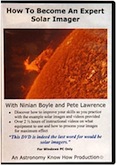 How To Become and Expert Solar Imager. This instructional DVD resulted from a collaborative effort by Ninian Boyle and Pete Lawrence, two experienced amateurs who are using solar filtered telescopes the same as those you can buy from Company Seven. Their DVD presents information in a comprehensible manner explaining what types of imaging you can do whether it be white light imaging of the Sun or using the more interesting modern hydrogen-alpha filters and telescopes; they conduct you through the entire process step by step. Their work has featured prominently in works by the BBC (British Broadcasting Corporation), astronomy publications, as well as in advertisements for companies that manufacture equipment for amateurs and professionals including Coronado and Solarscope Ltd. for example.
• More than two and one-half (2-½) hours of instructional video covering topics including what to use, how to capture images, and the final post-processing of the image data to produce stunning pictures.
• FREE image processing software*: all that you'll need to commence processing and finalizing your images.
• Sample processed images and videos supplied by Pete for you to refer to, and
• unprocessed images and videos supplied by Pete so that you may practice processing; you can make your mistakes in safety!
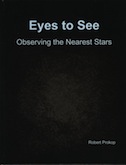 Added another title to our list of our most recommended books; the book Eyes To See: Observing the Nearest Stars is written by a customer of Company Seven, who got his start into visual astronomy not too many years ago. So this is an excellent read not only for those seeking a guide to how to find some interesting stars in the night sky and their history, but about how astronomy just might help you to find yourself.

 "Company Seven: Zeiss Lens Cleaning Fluid Materials Safety Data Sheet", our six (6) page color illustrated document explaining the health and safety implications of the Carl Zeiss Lens Cleaning Fluid distributed by Company Seven, and as is referred to in our article "Cleaning Telescopes And Most Consumer Optics". This document includes advice for medical professionals regarding treatment of accidental exposure to the eyes or ingestion. From Company Seven's Archives. Download size is 10,109,563 bytes (in Acrobat Reader ".pdf" format).
"Company Seven: Zeiss Lens Cleaning Towelette Materials Safety Data Sheet", our six (6) page color illustrated document explaining the health and safety implications of the Zeiss Lens Cleaning Towlettes distributed by Company Seven and as is referred to in our article "Cleaning Telescopes And Most Consumer Optics". This document includes advice for medical professionals regarding treatment of accidental exposure to the eyes or ingestion. From Company Seven's Archives. Download size is 9,669,387 bytes (in Acrobat Reader ".pdf" format).
"Company Seven: Zeiss Lens Cleaning Fluid Materials Safety Data Sheet", our six (6) page color illustrated document explaining the health and safety implications of the Carl Zeiss Lens Cleaning Fluid distributed by Company Seven, and as is referred to in our article "Cleaning Telescopes And Most Consumer Optics". This document includes advice for medical professionals regarding treatment of accidental exposure to the eyes or ingestion. From Company Seven's Archives. Download size is 10,109,563 bytes (in Acrobat Reader ".pdf" format).
"Company Seven: Zeiss Lens Cleaning Towelette Materials Safety Data Sheet", our six (6) page color illustrated document explaining the health and safety implications of the Zeiss Lens Cleaning Towlettes distributed by Company Seven and as is referred to in our article "Cleaning Telescopes And Most Consumer Optics". This document includes advice for medical professionals regarding treatment of accidental exposure to the eyes or ingestion. From Company Seven's Archives. Download size is 9,669,387 bytes (in Acrobat Reader ".pdf" format).
that are well underway too. We expect to commence making deliveries of these mounts in October of 2012 through March or April 2013.
that are well underway. We expect to commence making deliveries of these telescopes in July-August 2012. For these products we refer to our waiting lists, sending invitations to notify people who have registered and who have a good relationship with Company Seven and their area astronomy communities. Accordingly, we have updated our Astro-Physics Telescope and Mount Availability information page.
Changes in September 2011:
DAR Constitution Hall at Washington DC. Stage viewed from our seats.
Image by M. Cohen with Apple iPhone camera (62,929 bytes).
Click on image to see enlarged view (362,758 bytes).
Sting with band onstage at DAR Constitution Hall. Image by M. Cohen
with pocket digital camera at maximum 3.8x zoom (62,929 bytes).
Click on image to see enlarged view (174,077 bytes).
Sting as we saw him on stage at DAR Constitution Hall. Image by M. Cohen
with pocket digital camera and Leica 10x 42 binocular (90,458 bytes).
Click on image to see enlarged view (109,794 bytes).
Sting closing the show at DAR Constitution Hall. Image by M. Cohen
with pocket digital camera and Leica 10x 42 binocular (22,462 bytes).
Click on image to see enlarged view (221,592 bytes).
)
Click on image to see enlarged view (446,834 bytes).
)
For some sense of scale the Finderscopes are two Baader Planetarium 10x 60mm (2.4 inch aperture) models, as sold by Company Seven, with PC computers in background.
Click on image to see enlarged view (123,390 bytes).
 Changes in March 2011:



between 15 May and 30 September 2009 from Company Seven, an Authorized North American Leica Retailer. This $350 program was organized since the original program (ending last month) was never well advertised, or announced in a timely manner, and was too limited - so Leica simplified and made it even better!
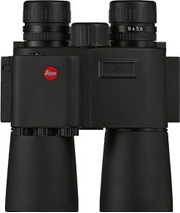
Changes in January 2008:
Changes in December 2007:
Changes in November 2007:
Changes in October 2007:
Check or Money Order
Mastercard

Traveler Check
PayPal
VISA
Western Union
Wire Transfer
"Gemini Control Center System Users Manual" The complete 83 page illustrated instruction manual as written by Daniel Goerlich, Michael Rudolph. Published April 2006.
"Gemini Astronomical Positioning System Users Manual Level 4" The complete 137 page illustrated instruction manual as written by Rene Goerlich, Michael Rudolph, David Sandage. Published April 2006.
DIOPTRX Technical Notes An illustrated two page overview of the DIOPTRX provided as an Adobe .pdf file, April 2005 by TeleVue Optics (328,734 bytes).
Understanding Your Eyeglass Prescription for Astigmatism An one page informative article describing visual astigmatism, particularly helpful in understanding the DIOPTRX Lenses. Provided as an Adobe .pdf file, April 2005 by Barry Santini of TeleVue Optics (27,634 bytes).
Changes in February 2005:
Changes through May 2004:
Changes through April 2004:
Changes through March 2004:
Changes through August 2003:
Changes through July 2003:
JUL 17, Your Telescope, Martin Cohen - the location of this talk is changed to the S. DILLON RIPLEY CENTER
JUL 24, Heavenly Bodies' Shape and Motion, David Dunham
JUL 31, Using Cheap Webcams and Freeware, Geoff Chester
AUG 7, Upstairs/Downstairs, David DeVorkin
AUG 14, Following Stars, Janet Mattei
Uranomaniac 2001.1 reprint of our popular but fictitious star atlas by Company Seven in response to the announcement of "Uranometria 2000".
Changes in April 2001:
20 March 2011 Event: Company Seven Supporting NASA Sun-Earth Day Activities (19 March)
20 March 2010 Event: Company Seven Supporting NASA Sun-Earth Day Activities

download the Sun-Earth Day 2010 Announcement in Adobe ".pdf" format as a reminder or for distribution.
20 March 2009 Event: Company Seven Supporting NASA Sun-Earth Day Activities

download the Sun-Earth Day 2009 Announcement in Adobe ".pdf" format as a reminder or for distribution.
4-5 December 2008 Event: Martin Cohen of Company Seven is guest speaker at Worchester Polytechnic Institute Integrative Materials Design Center

Above: logo of the Worchester Poly Integrative Materias Design Center (iMdc). The logo represents some aspect of industry benefitted by iMdc.
Click on image to see enlarged view.
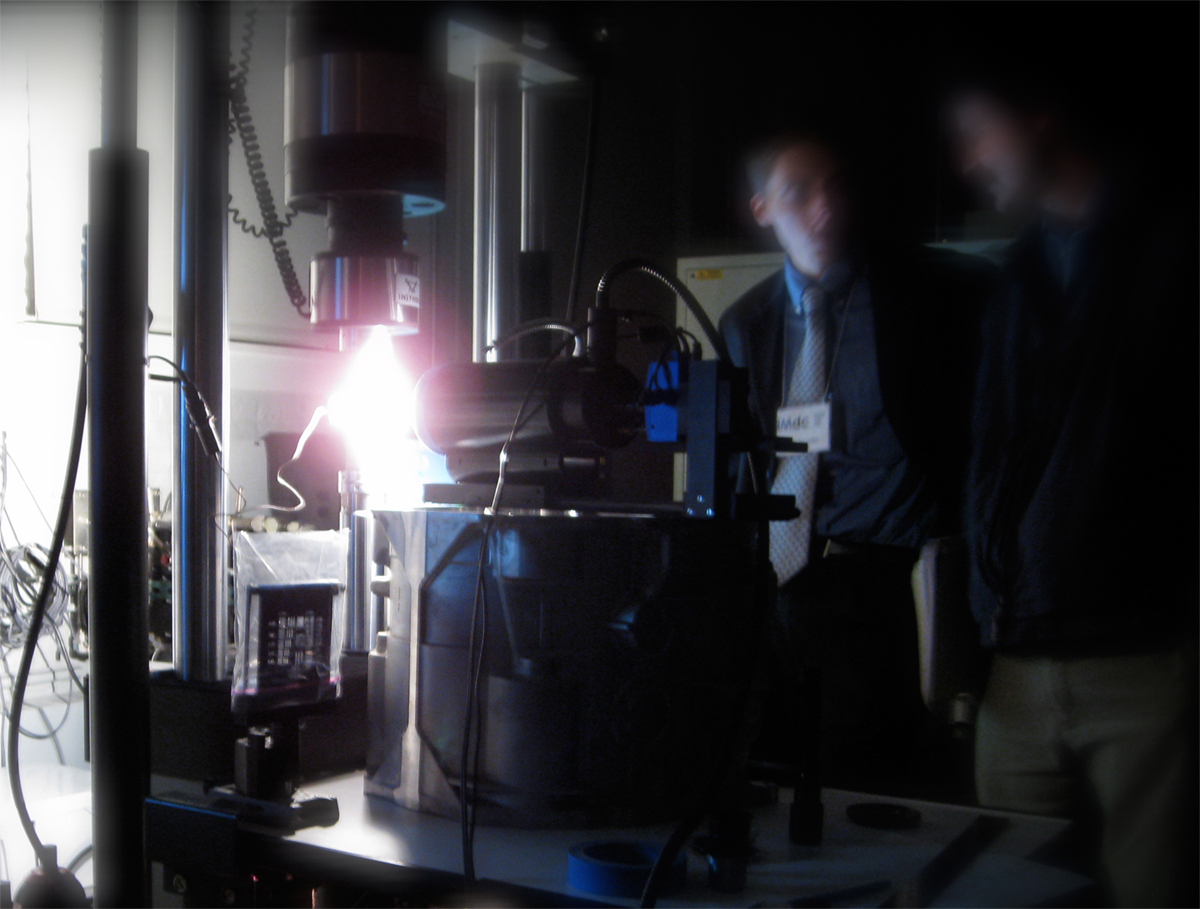 Right: Questar-QM-100 with Carl Zeiss HRc high resolution color camera demonstrating materials alloy sample crack propagation from mm to submicron resolution during iMdc Winter 2008 meeting laboratory session (115,902 bytes).
Click on image to see enlarged view (557,195 bytes).
20 March 2008 Event: Company Seven Supporting NASA Sun-Earth Day Activities

NASA's Office of Space Science (OSS) explores four broad themes: "Sun-Earth Connection," "Solar System Exploration," "Structure and Evolution of the Universe," and "Astronomical Search for Origins and Planetary Systems." For each of these themes OSS has created an "Education Forum" so that educators, students and the public can share the excitement of those discoveries and knowledge generated by Space Science missions and research programs. The Sun-Earth Connection Education Forum is a partnership between NASA/Goddard Space Flight Center and UC Berkeley's Space Sciences Laboratory whose mission is to increase science literacy and steward Sun-Earth Connection science resources. To visit the Web Site of the organizations involved, simply visit http://sunearth.gsfc.nasa.gov.
Download a copy of this announcement in ".pdf" format as a reminder or for distribution.
20 March 2007 Event: Company Seven Supporting NASA Sun-Earth Day Activities

Sun-Earth Day is comprised of a series of programs and events that occur throughout the year culminating with a celebration on or near the Spring Equinox. Over the past six years, the NASA's Sun-Earth Connection Education Forum has sponsored and coordinated education and public outreach events to highlight NASAs Sun-Earth Connection research and discoveries. The strategy involves using celestial events, such as total solar eclipses and the Transit of Venus, as well as Sun-Earth Day during the March Equinox, to engage K-12 schools and the general public in space science activities, demonstrations, and interactions with space scientists. This year's theme will be "Living In The Atmosphere of The Sun".
Download a copy of this announcement in ".pdf" format as a reminder or for distribution.
20 March 2006 Event: Company Seven Supporting NASA Sun-Earth Day Activities

Sun-Earth Day is comprised of a series of programs and events that occur throughout the year culminating with a celebration on or near the Spring Equinox. Over the past six years, the NASA's Sun-Earth Connection Education Forum has sponsored and coordinated education and public outreach events to highlight NASAs Sun-Earth Connection research and discoveries. The strategy involves using celestial events, such as total solar eclipses and the Transit of Venus, as well as Sun-Earth Day during the March Equinox, to engage K-12 schools and the general public in space science activities, demonstrations, and interactions with space scientists. This year's theme will be "Living In The Atmosphere of The Sun".
 In collaboration with partners that include science centers and museums around the world, the Exploratorium, NASA Connect, Sun-Earth Connection missions, Company Seven and others, NASA produces webcasts, other multi-media, and print resources for use by school and informal educators nation-wide and internationally. The NASA Sun Earth Forum provides training and professional development to K-12 educators, museum personnel, amateur astronomers, Girl Scout leaders, etc., so they can implement their own outreach programs taking advantage of our resources. A coordinated approach promotes multiple programs occurring each year under a common theme. The Sun-Earth Day website contains information for students, educators, scientists, museums and amateur astronomers! All web resources for prior events such as "Sun-Earth Day 2005: Ancient Observatories, Timeless Knowledge" are archived and will remain on-line for your enjoyment!
Download this year's Sun-Earth Day announcement in ".pdf" format as a reminder or for distribution.
20 March 2005 Event: Company Seven Supporting NASA Sun-Earth Day Activities
In collaboration with partners that include science centers and museums around the world, the Exploratorium, NASA Connect, Sun-Earth Connection missions, Company Seven and others, NASA produces webcasts, other multi-media, and print resources for use by school and informal educators nation-wide and internationally. The NASA Sun Earth Forum provides training and professional development to K-12 educators, museum personnel, amateur astronomers, Girl Scout leaders, etc., so they can implement their own outreach programs taking advantage of our resources. A coordinated approach promotes multiple programs occurring each year under a common theme. The Sun-Earth Day website contains information for students, educators, scientists, museums and amateur astronomers! All web resources for prior events such as "Sun-Earth Day 2005: Ancient Observatories, Timeless Knowledge" are archived and will remain on-line for your enjoyment!
Download this year's Sun-Earth Day announcement in ".pdf" format as a reminder or for distribution.
20 March 2005 Event: Company Seven Supporting NASA Sun-Earth Day Activities

Sun-Earth Day is comprised of a series of programs and events that occur throughout the year culminating with a celebration on or near the Spring Equinox which occurs this year on 20 March. Over the recent years, the NASA's Sun-Earth Connection Education Forum has sponsored and coordinated education and public outreach events to highlight NASAs Sun-Earth Connection research and discoveries. The strategy involves using celestial events, such as total solar eclipses and the Transit of Venus, as well as Sun-Earth Day during the March Equinox, to engage K-12 schools and the general public in space science activities, demonstrations, and interactions with space scientists. This year's theme will be "Ancient Observatories Timeless Knowledge".
20 March 2004 Event: Company Seven Supporting NASA Sun-Earth Day Activities

Sun-Earth Day is comprised of a series of programs and events that occur throughout the year culminating with a celebration on or near the Spring Equinox. Over the past six years, the NASA's Sun-Earth Connection Education Forum has sponsored and coordinated education and public outreach events to highlight NASAs Sun-Earth Connection research and discoveries. The strategy involves using celestial events, such as total solar eclipses and the Transit of Venus, as well as Sun-Earth Day during the March Equinox, to engage K-12 schools and the general public in space science activities, demonstrations, and interactions with space scientists.
Download a copy of NASA's Venus Transit 2004 announcement in ".pdf" format as a reminder or for distribution.
17 July 2003 Event: Martin Cohen speaking at Smithsonian Institution Resident Associates Summer Program
We are supporting the Smithsonian Institution Resident Associates Summer Program where Martin Cohen of Company Seven is among the invited guest speakers in the "Amateur Astronomy: It's All in the Stars … and Comets, Planets, and Moons" series.
JUL 17, Your Telescope, Martin Cohen - the location of this session changed to S. DILLON RIPLEY CENTER
JUL 24, Heavenly Bodies' Shape and Motion, David Dunham
JUL 31, Using Cheap Webcams and Freeware, Geoff Chester
AUG 7, Upstairs/Downstairs, David DeVorkin
AUG 14, Following Stars, Janet Mattei
20 March 2002 Event: Company Seven Supporting NASA Sun-Earth Day Activities

NASA's Office of Space Science (OSS) explores four broad themes: "Sun-Earth Connection," "Solar System Exploration," "Structure and Evolution of the Universe," and "Astronomical Search for Origins and Planetary Systems." For each of these themes OSS has created an "Education Forum" so that educators, students and the public can share the excitement of those discoveries and knowledge generated by Space Science missions and research programs. The Sun-Earth Connection Education Forum is a partnership between NASA/Goddard Space Flight Center and UC Berkeley's Space Sciences Laboratory whose mission is to increase science literacy and steward Sun-Earth Connection science resources. To visit the Web Site of the organizations involved, simply visit http://sunearth.gsfc.nasa.gov/SECEF_SunEarthDay/.
Download a copy of this announcement in ".pdf" format as a reminder or for distribution.
27 November 2001 Company Seven activates a new DayStar Calcium K Line Filter for Solar Observing!
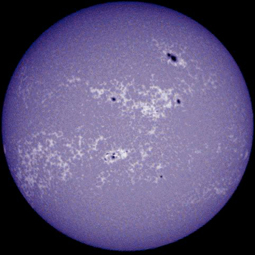 Left: Spectroheliogram of the Sun as shown through the DayStar Calcium K-Line Filter. (60,382 bytes. Image courtesy of NASA).
27-28 April 2001 Event: Company Seven Supporting NASA Sun-Earth Day Activities
Left: Spectroheliogram of the Sun as shown through the DayStar Calcium K-Line Filter. (60,382 bytes. Image courtesy of NASA).
27-28 April 2001 Event: Company Seven Supporting NASA Sun-Earth Day Activities
NASA's Office of Space Science (OSS) explores four broad themes: "Sun-Earth Connection," "Solar System Exploration," "Structure and Evolution of the Universe," and "Astronomical Search for Origins and Planetary Systems." For each of these themes OSS has created an "Education Forum" so that educators, students and the public can share the excitement of those discoveries and knowledge generated by Space Science missions and research programs. The Sun-Earth Connection Education Forum is a partnership between NASA/Goddard Space Flight Center and UC Berkeley's Space Sciences Laboratory whose mission is to increase science literacy and steward Sun-Earth Connection science resources. To visit the Web Site of the organizations involved, simply visit http://sunearth.gsfc.nasa.gov/SECEF_SunEarthDay/.
Download a copy of this announcement in ".pdf" format as a reminder or for distribution.
 Click here to download it free from Adobe's web site.

Contents Copyright 1994-2026 Company Seven and respective contributors - All Rights Reserved
)
)
)
)
)
)
)
)
)
)
)
)
)
)