|
C-7 Home Page
Losmandy Overview |
|||||||||||||||||||||||||||||||||||||||||||||||||||||||||||||||||||||||||||||||||||||||||||||||||||||||||||||||||||

|
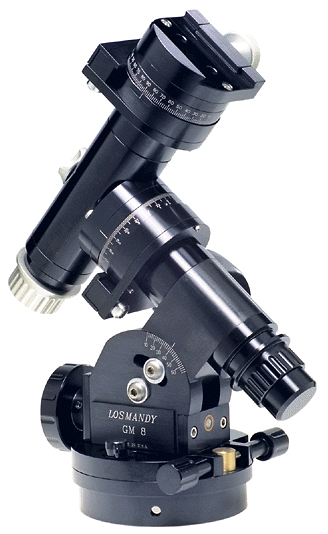
LOSMANDY GM-8 AND G-11 GERMAN EQUATORIAL MOUNTSSince its introduction in the Spring of 1992 the Losmandy Model G-11 German Equatorial mount has come to represent the best value in its class and a particularly attractive choice for those who require a high degree of tracking precision and reliability. Learning by experience and responding to increasing demands from demanding astrophotographers the G-11 was improved over the years so that it presently provides payload capacities of up to 6 inch refractors, or up to 12 inch aperture Schmidt Cassegrain telescopes. In order to compete in the marketplace for lighter weight precision mounts, Losmandy reduced the bearing and gear set dimensions of the G-11 and developed a more compact folding tripod to produce the GM-8. And on the other side of the G-11, for people who seek a platform engineered for telescopes such as the Celestron C-14, and Astro-Physics 10" Mak, Losmandy developed the HGM Titan mount.These mounts are fully machined from virgin metals stock on precision Computer numerical control (CNC) milling machines in California. In spite of other mount encroaching the market that may resemble these, or that claim similar payload capacities, no other mounts in this price class provides this balance of payload capacity, low periodic error control, reliability, serviceability; Company Seven views these mounts as being among the least expensive truly precision-made tracking platforms of their class. Furthermore, the Losmandy mounts and their operating systems have been so popular for nearly two decades that there is a large installed user base of accomplished users; we are confident there will many sources of parts and advice for years to come.
While the smaller GM-8 remains very popular, the G-11 mount is a particularly attractive choice for those who require a high degree of performance and reliability. And for users who require utmost reliability, who find it inconvenient to obtain repair assistance at remote locations the GM-8 and G-11 mounts are a high performance platform whose components are modular, symmetrical, and fairly simple to service or replace in the field. In fact these mounts are available with either the proven Losmandy Model 492 stepper motor drive and control system or with the Gemini 'Go To' computer control system; either can be installed or replaced in the field! Our experience is that there is rarely a need to return a head to the USA for service more so since Company Seven technicians put in several man hours checking through and fine tuning each new mount which we receive. You are not likely to encounter any defect that would require a return of the head sold by Company Seven for service. An equatorial mount is judged by it payload capacity and tracking accuracy. Payload ratings of mounts vary in the manner with which the manufacturer judges their product, so this number alone may not be a consistent predictor of capacity. What is most important to the user of the product is how rigidly the mount holds the payload, how smoothly it tracks (amplitude and smoothness of the periodic error of a gear), and how it overcomes the moment imparted by the load. The weight put onto the mount will vary depending how the instrument is to be used too for example one telescope used for visual work only may be as much as fifty percent lighter in weight than another employed for imaging (with guide scopes, cameras, filter wheel, etc.). The potential loading on the mount may also vary with local winds so even a mild wind accross the "sail" area of a large reflecting telescope can dramatically increase the effective load imparted to the mount. So a small mount operating from within a shelter (such as a dome or shed) with a short and narrow telescope might perform as well or better than a larger mount outside a sheltered environment. Indeed, some people elect to buy a smaller mount and then put the balance saved by not buying a larger mount into a shelter. A mount in this performance class tracks very well making it suitable for the most demanding astrographic applications. This is quantified by measuring the amplitude and smoothness of the periodic error of a gear. The period of the GM-8 Worm Gear is 8 minutes, that of the G-11 is 4 minutes. By measuring the up and down motion of a star being tacked over this period we can measure this error. The typical GM-8 delivered by Company Seven will have something under 20 Arc. Secs. of periodic error (peak to peak). While the recent production G-11 mounts that leave Company Seven will average about 10 Arc. Secs. So the unguided tracking precision of these mounts are among the best in their price class. The amplitude is reached over a broad smooth period, not jerky or rapid. When one employs the Periodic Error Control circuit (of the Gemini), specialized software ("PemPro" for example), or guides the mount with an automatic CCD system then this error can be reduced to much less. Note when using the mount with an autoguiding CCD we teach our customers to turn off the PEC. Read Company Seven's Review of the original Losmandy G-11 Mount with Celestron C-11 telescope. This was a revolutionary departure from the previous traditional fork mounted arrangements being the first large SCT optical tube assembly sold mated to a German Equatorial platform. The CG-11 became the most successful mid aperture Schmidt Cassegrain telescope system ever sold by Company Seven. |
||||||||||||||||||||||||||||||||||||||||||||||||||||||||||||||||||||||||||||||||||||||||||||||||||||||||||||||||||
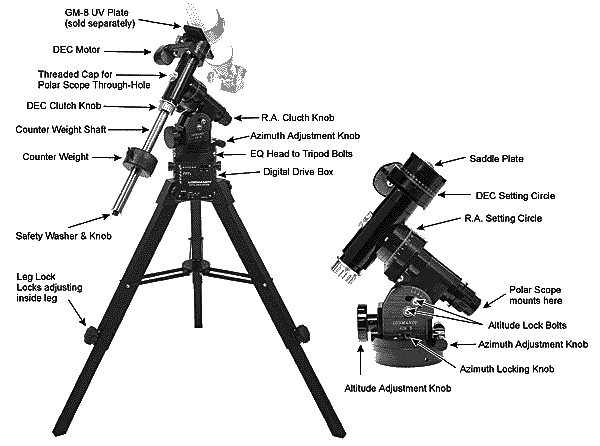
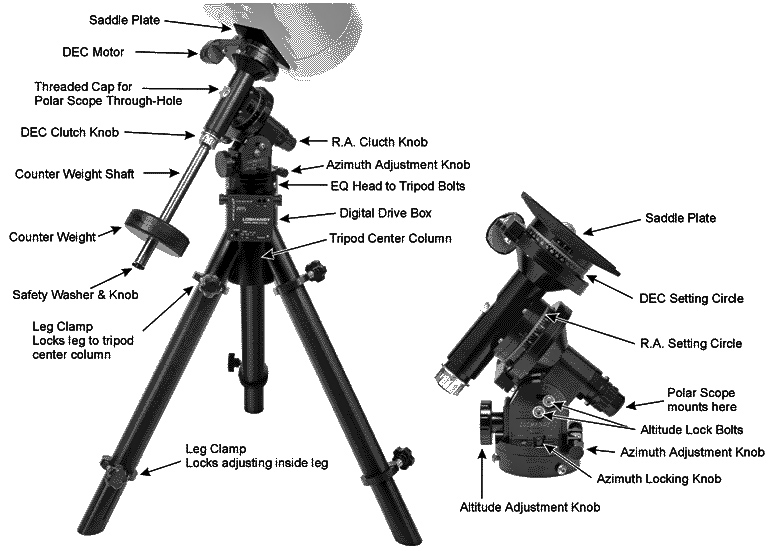
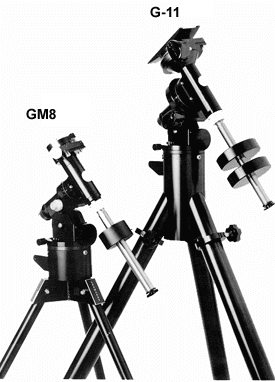
Above: Losmandy GM-8 (left) and G-11 (right) mount arrangements. Click on the images to see enlarged view. |
|||||||||||||||||||||||||||||||||||||||||||||||||||||||||||||||||||||||||||||||||||||||||||||||||||||||||||||||||||
|
Common Features of both GM-8 and G-11 Mounts:
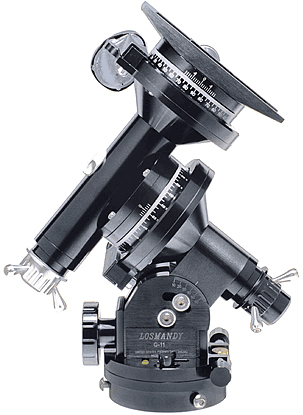 Right: Losmandy Model G-11 German Equtorial Mount Head shown without furnished tripod, counterweight shaft.
Clutch adjustment handles shown are optional. Click on image to see enlarged view.
G-11 Instruction Manuals
* Power Source Notes we suggest the user consider one of the following options:
* Specifications subject to change. GM-8 Instruction Manuals
POPULAR AVAILABLE OPTIONS FOR THESE MOUNTSAccessories Section for illustrations and descriptions
|
|||||||||||||||||||||||||||||||||||||||||||||||||||||||||||||||||||||||||||||||||||||||||||||||||||||||||||||||||||

|
Contents Copyright 1994-2007 Company Seven - All Rights Reserved |
||||||||||||||||||||||||||||||||||||||||||||||||||||||||||||||||||||||||||||||||||||||||||||||||||||||||||||||||||

 "Losmandy™ Model G-11 Instruction Manual"