|
C-7 Home Page
Losmandy Overview |
|||||||||||||||||||||||||||||||||||||||||||||

|
LOSMANDY HGM TITAN GERMAN EQUATORIAL MOUNT
'Go To' Computer Controlled Mount
Since its introduction in the Spring of 1992 the Losmandy Model G-11 German Equatorial mount has come to represent the best value in its class and a particularly attractive choice for those who require a high degree of tracking precision and reliability. The G-11 has been improved over the years so that it presently provides payload capacities of up to 6 inch refractors, or up to 12 inch aperture Schmidt Cassegrain telescopes. There are people who consider even larger telescopes to be "portable" and so for those people who seek a platform engineered for telescopes such as the Celestron C-14, and Astro-Physics 10" Mak, Losmandy developed the HGM Titan announced in October 2002. These mounts are fully machined from virgin metals stock on precision Computer numerical control (CNC) milling machines in California. In spite of other mount encroaching the market that claim similar payload capacities, no other mount in this price class provides this balance of payload capacity, low periodic error control, reliability, serviceability; Company Seven views the Losmandy mounts as being among the least expensive truly precision-made tracking platforms of their class. Furthermore, the Losmandy mounts and their operating systems have been so popular for nearly two decades that there is a large installed user base of accomplished users; we are confident there will many sources of parts and advice for years to come.
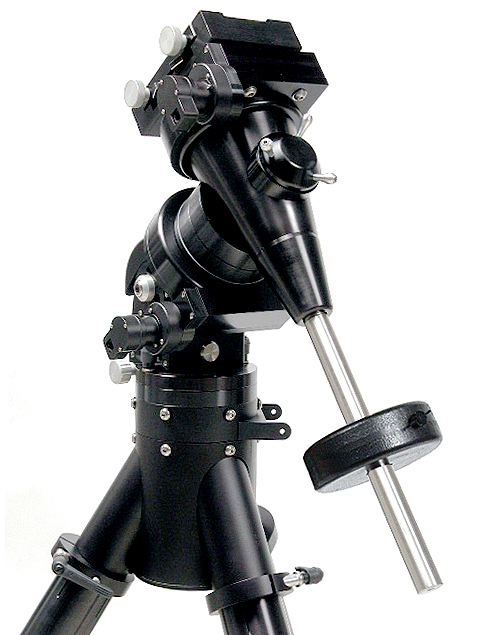
Right: Losmandy Titan Mount Head with Tripod, 21 lb. Counterweight (63,202 bytes). At first glance the resemblence of the Titan to the larger HGM-200 mount is obvious The Titan appears to be a scaled down HGM-200. But this is a mount that was engineered from the ground up to take advantage of the dramatic developments in mount drive corrector and computer control technology. In fact this mount is available with only the proven Losmandy Gemini 'Go To' computer control system. As has been the case with most Losmandy mounts, it is a valuable asset that the Titan too is a mount among the few high performance platforms whose components are modular, symmetrical, and fairly simple to service or replace in the field. Our experience is that there is rarely a need to return a head to the USA for service, even more so since Company Seven technicians put in about four to five man hours checking through and fine tuning each new Losmandy mount which we receive. You are not likely to encounter any defect that would require a return of the head sold by Company Seven for service.
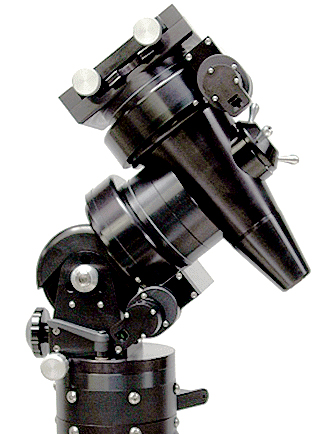
Left: Losmandy Titan Mount Head (59,558 bytes). It is expected that mount in this performance class should track very well, it should suitable for the most demanding astrographic applications. This can be quantified by measuring the amplitude and smoothness of the periodic error of a gear. The period of the Titan Worm Gear is 5.3 minutes. By measuring the up and down motion of a star being tacked over this period we can measure this error. The typical Titan delivered by Company Seven will have 8 Arc. Secs. or less of periodic error (peak to peak); the tracking precision of the Titan is among the best in its price class. The amplitude is reached over a broad smooth period, not jerky or rapid. When one employs the Periodic Error Control circuit (of the Gemini), specialized software ("PemPro" for example), or guides the mount with an automatic CCD system then this error can be reduced to much less to something on the order of 2 Arc. Secs. or less. Note when using the mount with an autoguiding CCD we teach our customers to turn off the PEC. As mentioned above, Titan includes the Gemini 'Go To' computer control system. But for use on Titan the R.A. and Decl. drive motors are the Swiss made Maxon. This is an upgrade over the standard motors provided with the Gemini systems of the smaller GM-8 and G-11 mounts. The Maxon motor provides: 1. Standard motors employ three magnets and provide three poles parallel to the shaft. As you manually turn the motor shaft you can feel a pulsing three times per revolution with the standard motors. The Maxon motor has nine poles furthermore, these are not just parallel to the shaft but are spun to form a helix around the shaft. So when the Maxon motor turns one is less likely to feel any pulse, the motor has a a lower frequency vibration and this can be seen visually as improved fine detail on planets for example. 2. The Maxon motors provide an increase of 30 per cent torque over the standard motor. These motors can run the mount better at 12 volts (by cutting top end slew rates) and better at 18 volts than the standard motor.
Company Seven offers the Titan with a 'Delete Tripod Option'. If you choose to buy the Titan mount without the standard field tripod then you may deduct $200 from the cost. It is noteworthy that this deletion of a tripod is likely to notably cut shipping costs for overseas customers. |
||||||||||||||||||||||||||||||||||||||||||||
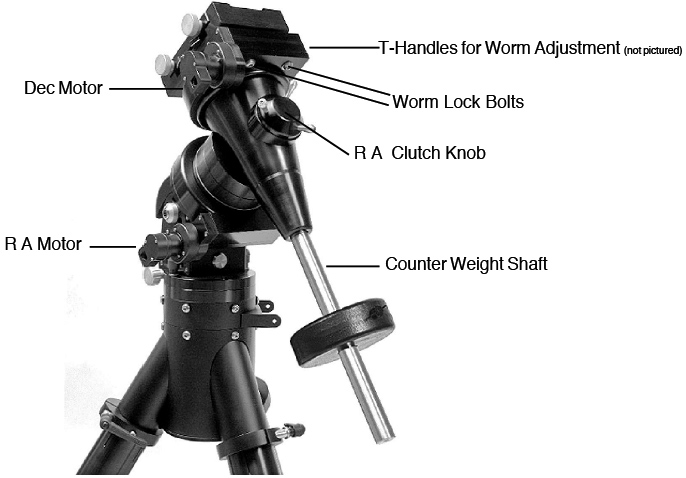
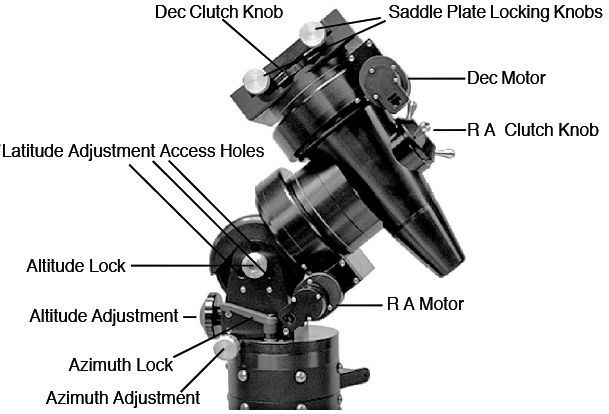
Above: Losmandy Titan Mount Head Arrangement. Click on the images to see enlarged view. |
|||||||||||||||||||||||||||||||||||||||||||||
Features of the Model HGM Titan Mount
Popular Options Include
|
|||||||||||||||||||||||||||||||||||||||||||||

|
Contents Copyright 1994-2007 Company Seven - All Rights Reserved |
||||||||||||||||||||||||||||||||||||||||||||