|
C-7 Home Page
Celestron History
|
|||

|
Celestron Schmidt-Cassegrain TelescopesWe are no longer updating the Celestron section of our web site. Some discontinued items are included for public information purposes only. Please contact us for information and advice about current Celestron models that we offer. Or visit our visit our showroom - one of the last and most enduring astronomy-oriented showrooms in the Americas.
|
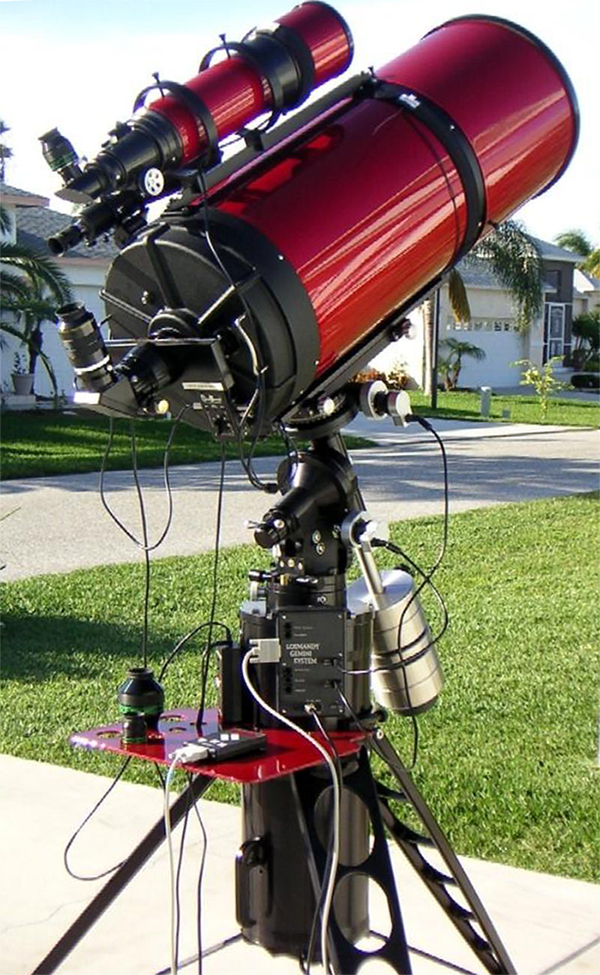
The Schmidt-Cassegrain telescope is a "Catadioptric" design. This design employs the features of both refracting and reflecting (all-mirror) designs. A primary, and a secondary mirror work with a thin aspheric corrector lens (the glass plate at the front) gather and reflect light to focus at a point behind the rear of the telescope. An eyepiece for viewing, or a camera (film or video) for photography may be attached to the focuser. These telescopes are portable, well suited for astrophotography, and due to their popularity a wide selection of photo-visual accessories are available. With its short, compact design (compared to other mirror or refractor telescopes) the Schmidts are very popular with "suburbanites" who travel from the city for better viewing conditions, and those who prefer the simpler to use fork mount.
The combination of individually hand matched optics, with precise drive systems incorporating features of practical value, and sound mechanics make the Celestron Schmidt-Cassegrain telescope (SCT) the best available. Celestron has long been recognized as the leader in fairly consistent quality, mass produced Schmidt-Cassegrain optical technology. From compact, multi-purpose sizes of as small as 5 inch up to an impressive 14 inch aperture the Celestron SCT's are internationally appreciated.
All of the primary optics, and all mechancial components of Celestron Schmidt-Cassegrain telescopes are made and assembled in the United States:
In a published "Sky & Telescope" magazine review, the Celestron SCT had the best light transmission by a large margin over the competition.
In fact, everything you see at similar magnification - stars, galaxies, nebulae - appears just as bright at f/10 as it does when using a telecompressor at f/6.3. While when using the same magnification, the image in the f/6.3 SCT is fainter. Celestrons Focal Reducer/Corrector (#94175) is our favorite optional SCT telecompressor. This accessory permits an f/10 system function at f/6.3 (f/7 on a C14). And it incorporates a field flattening element to maintain image quality across the entire field of view. This is almost a necessary accessory or those who prefer a faster system for certain astrophotography and CCD applications, and for economical fantastic wide field observing with 1.25" oculars; the results are astonishing!
And a standard feature for all worm gear driven C-8, and the C-14 optical tubes made since the summer of 1998 is the "Fastar" concept. This is where the optical tube has an easily interchanged secondary mirror housing that will accept an optics set and adapter to accommodate a CCD camera for operation at about f2!